Black and white photograph of Hugh MacKechnie and Lachlan MacDonald.
L-R: Hugh MacKechnie and Lachlan MacDonald, both of Kilmoluaig and Glasgow, photographed in Glasgow in the 1940s. (Hugh MacKechnie is an uncle of the donor, Margaret Campbell of Kilmoluaig.)
Gott Bay pier
Postcard of Gott Bay pier.
Courtesy of Mrs Maggie Campbell
The original pier at Gott Bay, built between 1909 and 1913, extended nearly 240 metres into the bay. Several aspects of the first design were altered. The planned iron and timber viaduct was abandoned and substituted with reinforced concrete construction.
Access to the low-water slip was moved from the centre of the pier-head to the back. This led under the pier to the main deck of the boat and was used for loading animals. The pier-head itself was built on timber piles.
The piles arrived on the island with square ends and were sharpened to a point by a Swedish carpenter using an axe. When the axe broke, Lachie MacKinnon (Lachlan Mac Eòghainn Ruaidh), a boat-builder in Vaul, took over the job using an adze until a new axe was available.
Black and white postcard of Gott Bay pier.
Gott Bay pier.
Black and white postcard of a cattle show at Crossapol
Postcard of a cattle show at Crossapol.
Black and white photograph of the MacDonald sisters of Balemartine.
The MacDonald sisters from Balemartine with an unknown friend from Uist, photographed while they were in service in Glasgow in the 1920s. L-R: Unknown, Sarah MacDonald, Mary Jane MacDonald (m.s. MacLean), Chrissie MacDonald (m.s. MacDonald), Neilina MacDonald (m.s. MacCallum). (Mary Jane is the mother of the donor, Margaret Campbell of Kilmoluaig.)
Black and white photograph of Donald Campbell and Margaret MacKechnie on their wedding day in 1953.
The wedding of Donald Campbell and Margaret MacKechnie at Heylipol church on 17/7/1953. The piper is Hugh Kennedy of Kilmoluaig and Glasgow. The man to the right with the watch chain is the late George Paterson, father of Mairi Campbell, Corrairigh, and the taller of the two girls is Flora Gunn, Moss.
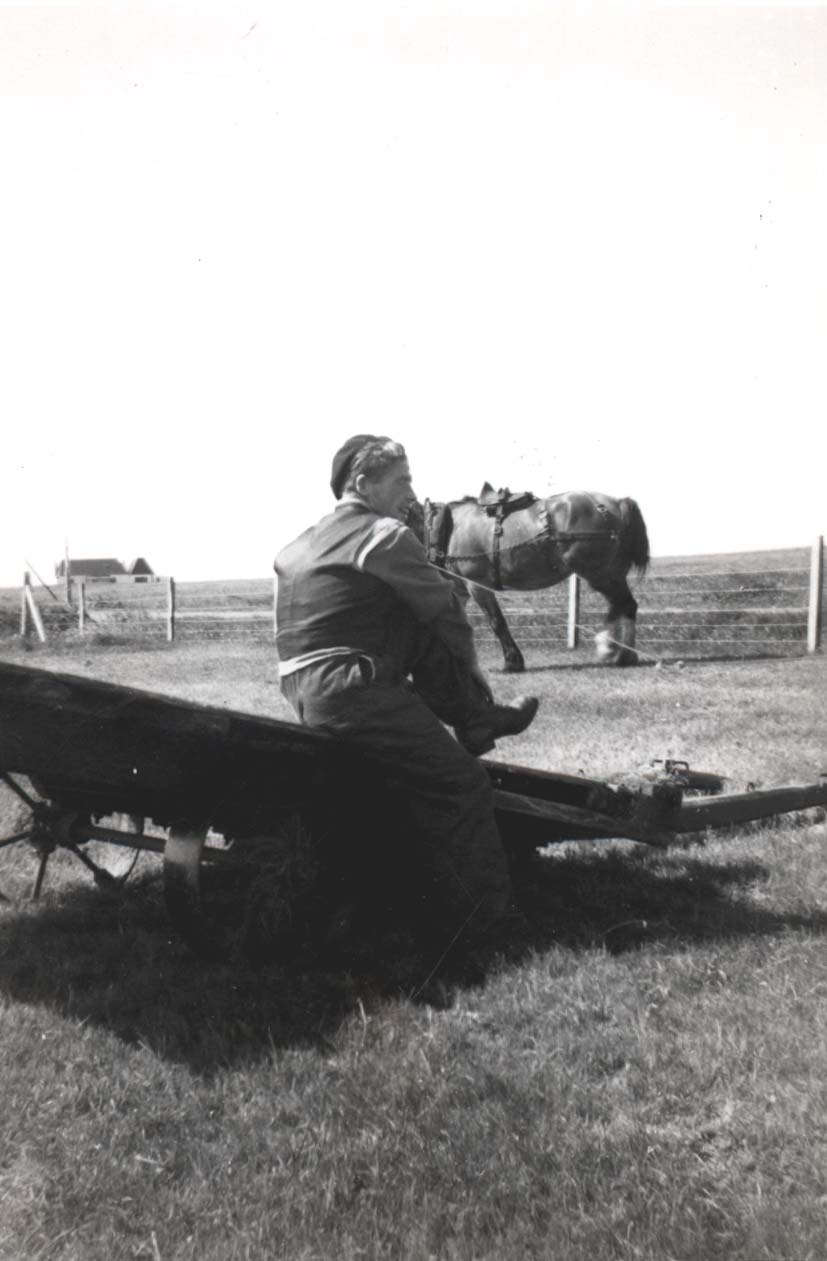
Black and white photograph of Alexander Campbell, Moss taken in the 1930s.
Alexander Campbell of Moss with his horse and cart taken in Moss in the 1930s. (Grandfather of Nancy MacKechnie, Crossapol and Maggie Campbell`s father-in-law)
Black and white photograph of unknown group behind Hough.
Unknown group of people behind Hough.
Black and white photograph of Donald Archie MacLean, Kilmoluaig, moving hay.
Donald Archie MacLean (Doris Lochside`s brother-in-law) moving hay from wet to drier ground in the 1940s.
Black and white photograph of Neil MacLeod, Carrachan, in the 1940s.
Neil MacLeod of Carrachan, Kilmoluaig, haymaking at Lochside in the 1940s.
Tug o’ war in the 1930s
Photograph of a tug o’ war at a Tiree Association Sports Day in the 1930s.
Courtesy of Mrs Maggie Campbell
This photograph shows the annual tug o’ war held at the Tiree Association’s Sports Day at Cornaig School in the 1930s. For the competition two teams position themselves at either end of a rope which is marked in the centre and four yards either side of the centre line.
The centre of the rope is positioned over a mark on the ground. At the command to pull, each team endeavours to pull the other team so that the mark on the rope nearest the opposing team crosses the centre line on the ground.
Traditionally visitors compete against a local team. The last event of the sports day, the tug o’ war is fiercely, though good-naturedly, contested.
Black and white photograph of a tug o` war at a Tiree Association sports day in the late 1930s.
Tug o` war at a Tiree Association sports day held at Cornaig School in the late 1930s.