


Large glazed stoneware flagon, 425 mm high, bottom three-quarters uncoloured, top quarter in orange-brown, made by Henry Kennedy, Barrowfield Pottery, Glasgow and stamped on the front with `3 JOHN FLETCHER Merchant TOBERMORY`.
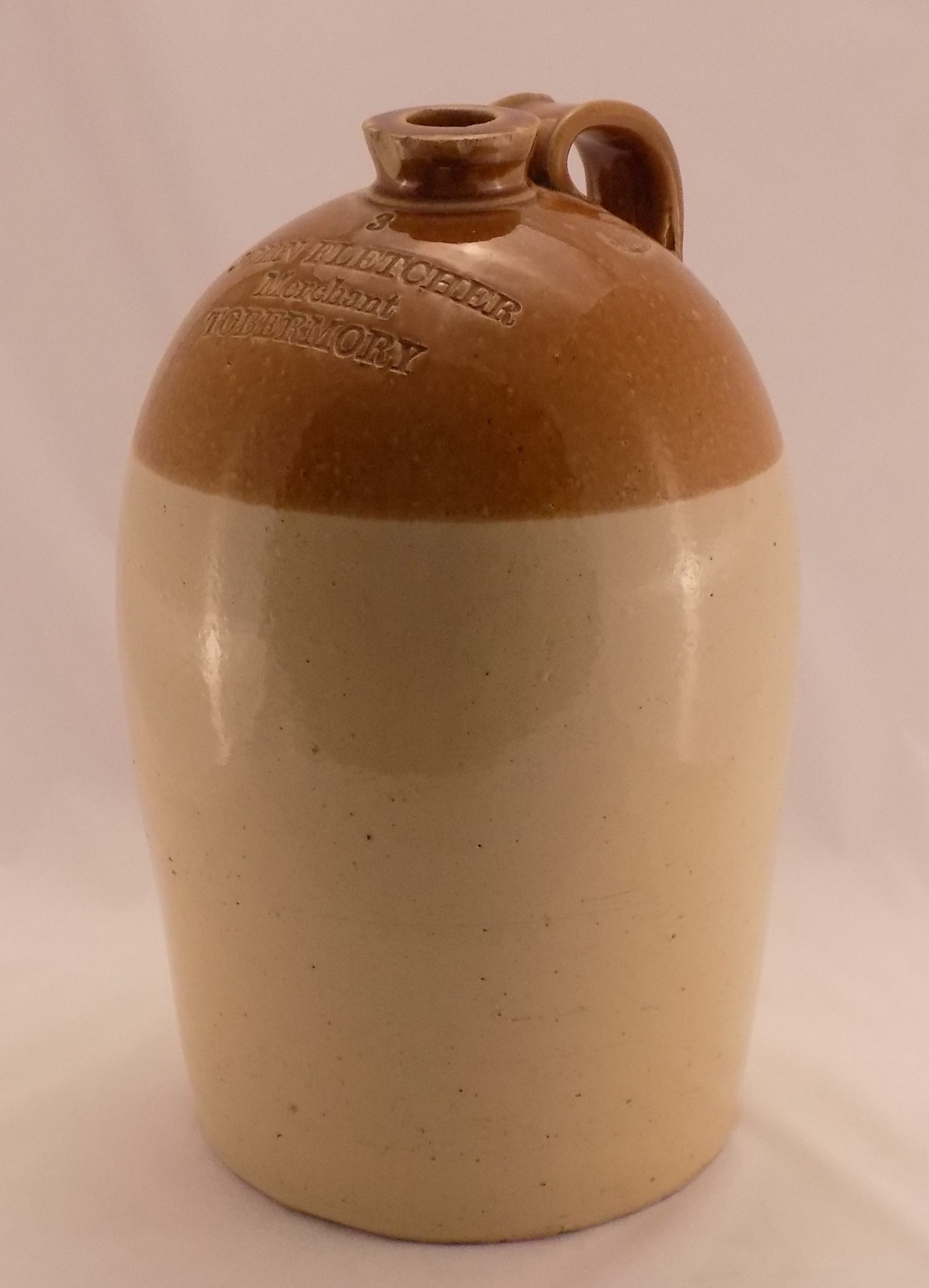

Large glazed stoneware flagon, 425 mm high, bottom three-quarters uncoloured, top quarter in orange-brown, made by Henry Kennedy, Barrowfield Pottery, Glasgow and stamped on the front with `3 JOHN FLETCHER Merchant TOBERMORY`.
Medical equipment from Tiree Airport.
Medical equipment found at Tiree Airport, consisting 4 tourniquets, 1 corkscrew (1960), 1 urinometer, 2 x 4oz cotton wool (1952), 2 magnifying glasses, ether masks, airways, needle holder (1959), assorted catgut ampoules size 0.1, aromatic ammonia capsules, standard dressing no. 9, 2 standard dressings no. 12 (1945), Enflavine dressing no. 12, 3 shell dresssings (1944), dibromopropamidine cream, eye solution no. 1, finger dressing, sterliser with burner, 2 blood administration sets, 6 chloroform ampoules (1939; empty), 2 silkworm gut.

Postcard of Mannal
Postcard of Mannal taken from Am Meall, postmarked 1950. Labelled “Balemartine”.

Photocopied newspaper article about Private John MacFadyen from Balemartine.
Article and photograph of Private John MacFadyen who was fatally wounded in action in Italy and died on 20 August 1944 aged 20. He was the son of John MacFadyen, Balemartine.
Box of slate pencils.
Plywood box covered with purple paper except on the lid which is illustrated in colour with a Union Jack and scenes from the battles of Trafalgar and Waterloo. Contains four slate pencils. Trademark `The Box`, made in Germany.

Block forming part of pulley found in Hynish.
Block forming part of pulley found in a shed opposite Milton House in Hynish by Patrick Lorimer.
Black and white photograph of Denis Snow from ENSA in 1942.
Denis Snow from ENSA in 1942, the first man to bring moving picture shows to Tiree. (Photograph from Mike Hughes in Filing Cabinet 2 drawer 1)

Flight Lieutenant Max Bacon and his aircrew from RAF 518 Squadron
Photograph of Flight Lieutenant Max Bacon and his aircrew from RAF 518 Squadron.

Courtesy of Mr Mike Hughes
Flight Lieutenant Arthur ‘Max’ Bacon (4th left) and his aircrew from RAF 518 Squadron are pictured beside their Halifax which was lost on operations over the Atlantic in January 1945.
RAF 518 Squadron arrived on Tiree in September 1943 to fly weather reconnaissance missions in long-range Halifax aircraft. Twice a day flights ‘Bismuth’ and ‘Mercer’ left Tiree for a ten-hour-long trip out into the Atlantic at either 20,000 or 50 feet.
Pressure to fly was relentless and in 1944 518 Squadron flew every day but two. Often icing and waves 100 feet high made this dangerous. 518 Squadron lost twelve aircraft during their spell on Tiree. That night in January, Max and his crew disappeared without trace.
Black and white photograph of Flight Lieutenant Max Bacon and his aircrew during World War II.
Flight Lieutenant Max Bacon (4th left) and his aircrew from RAF 518 Squadron beside their Halifax which was lost on operations over the Atlantic on 21/1/1945. Far right: F/Sgt Tony Porazka (Met. Air Obs., Polish). (Photograph from Mike Hughes in Filing Cabinet 2 drawer 1)
Black and white photograph of an RAF Concert Party in 1944.
RAF Concert Party in 1944. L-R: Fred MacKeown, Fred Parratt, Jessie MacQueen, Denis Guest, unknown, Bryn Lewis, Nan Hogarth, Frank Murphy, Dodo Leslie, Jack May, Jean Hind, Jim Worthington, Nettie MacFarlane, Harry Smith, Harry Barr, Paul Blomley. (Photograph from Mike Hughes in Filing Cabinet 2 drawer 1)

Black and white photograph of an RAF truck at Balephuil.
RAF truck at Balephuil during World War II. (Photograph from Mike Hughes in Filing Cabinet 2 drawer 1)
