


Colour photograph of the fish trap between Eilean nan Gobhar and Heanish in 2004.
The fish trap between Eilean nan Gobhar and Heanish, photographed by Dr John Holliday in 2004.


Colour photograph of the fish trap between Eilean nan Gobhar and Heanish in 2004.
The fish trap between Eilean nan Gobhar and Heanish, photographed by Dr John Holliday in 2004.
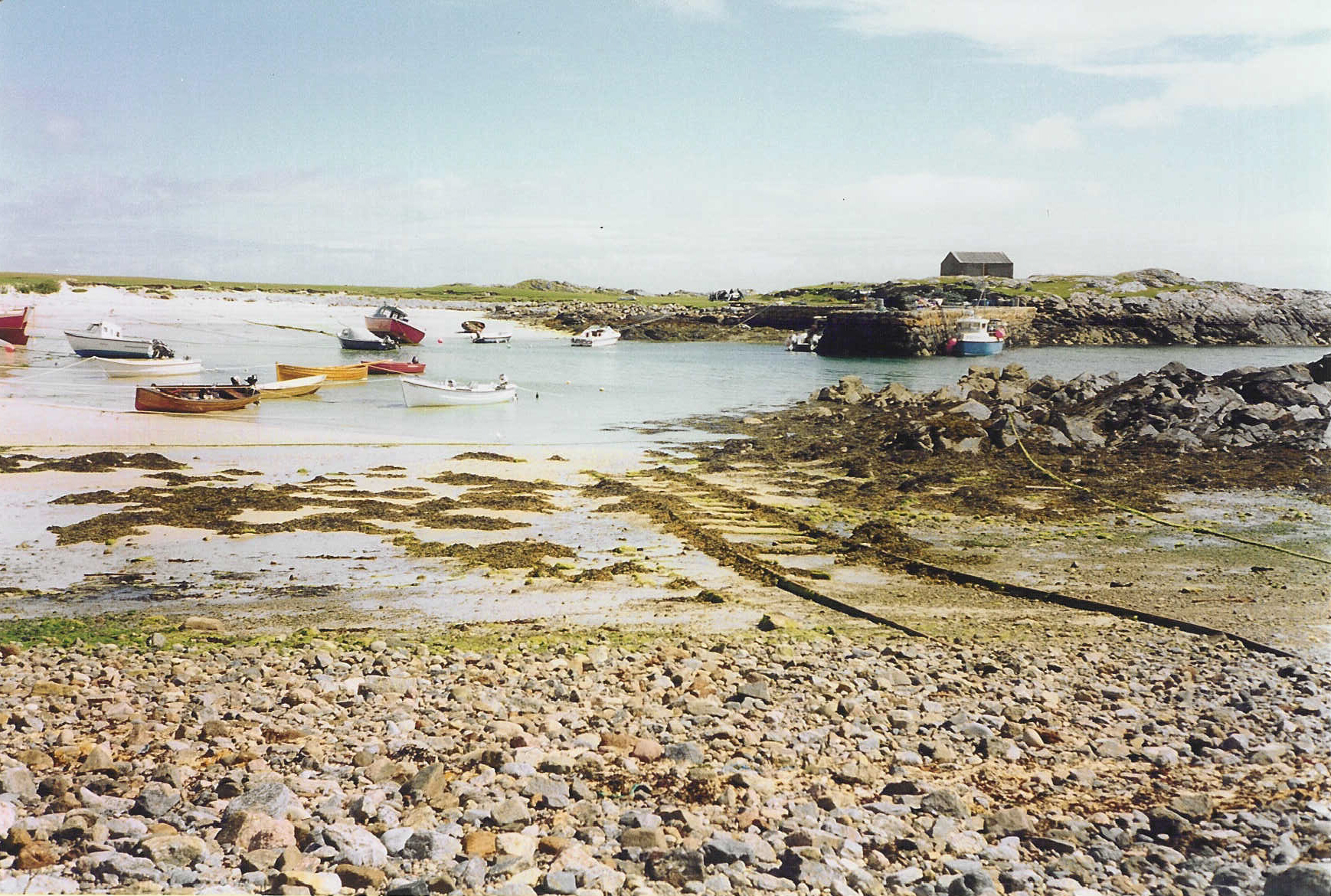
Colour photograph of Scarinish harbour in 2004.
The railway at Scarinish harbour used to beach the `Spindrift` in a cradle, photographed by Dr John Holliday in 2004.
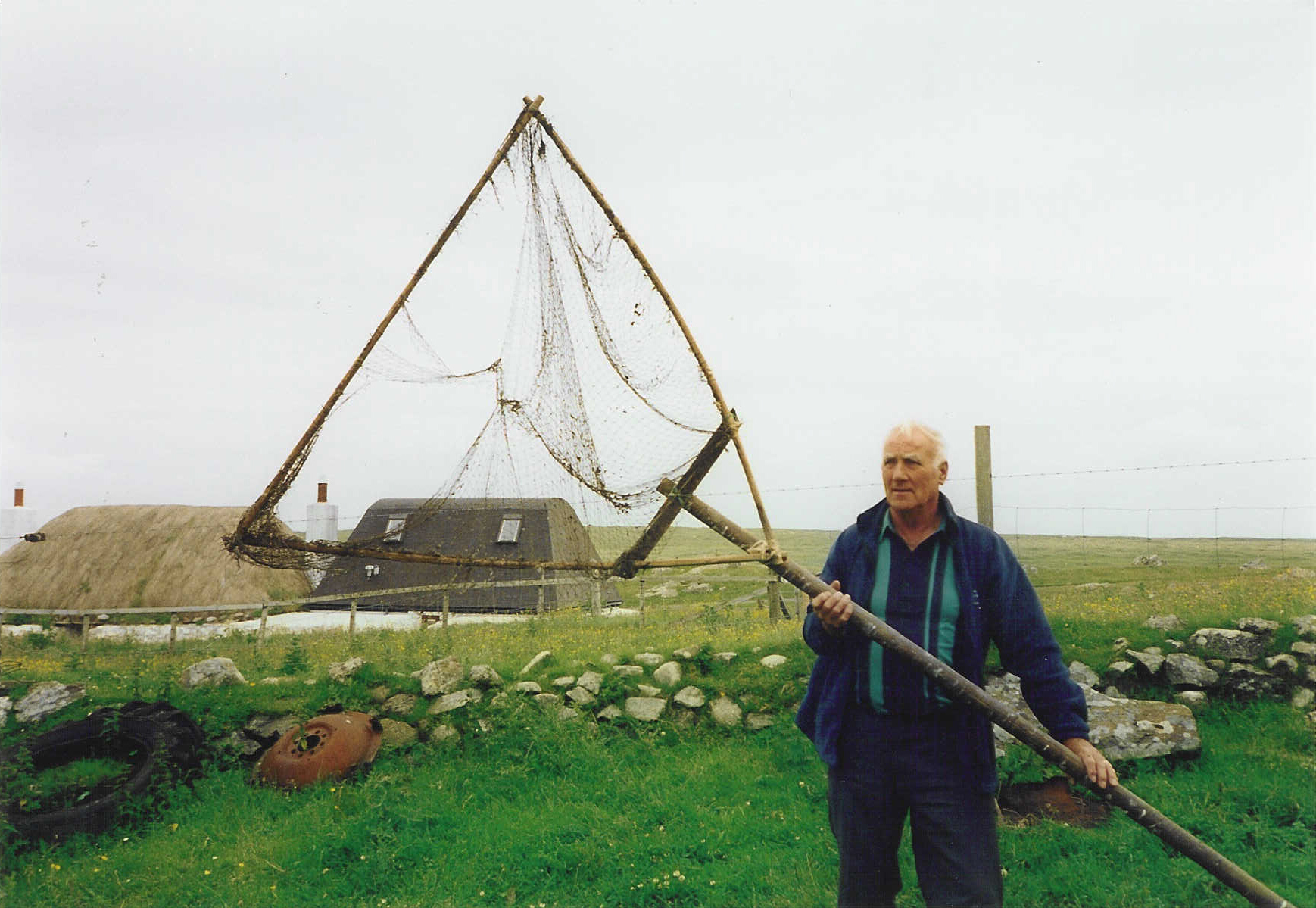
Donald Archie Brown of Balevullin with an ‘àbh’
Photograph of Donald Archie Brown of Balevullin with an ‘àbh’.
Courtesy of Mr Donald Archie Brown
Donald Archie Brown from Balevullin is holding an ‘àbh’, a large triangular net on a long handle used to fish for cuddies (small fry) from certain rocks. Derived from the Old Norse word ‘haaf’ meaning sea, it may have been introduced to Tiree after the arrival of the Vikings in the 9th century AD.
The pieces of wood making up the ‘àbh’ were bound together with cord as nails or bolts would rust and split the wood. It was heavy and dangerous with a full net and used only by stronger, more experienced men.
The best time to use the ‘àbh’ was at dusk. The fish were brought close to the rock with bait, traditionally by spitting out chewed raw limpets. Then a handful of ‘siaban’, dried shell sand, was thrown on the surface of the water so that the fish could not see the net coming from above.
Colour photograph of Donald Archie Brown with an `abh` in 2004.
Donald Archie Brown of Balevullin with an `abh` made from an oar and herring net belonging to Donald Kennedy and made by Donald MacNeill, photographed by Dr John Holliday in August 2004.
Colour photograph of Dr Holliday`s skiff `Ros` in Scarinish harbour in 1999.
Dr John Holliday`s skiff `Ros`, photographed in Scarinish harbour by Mary Norton in 1999.

Colour photograph of the skiffs `Ros` and `Joanne` in Scarinish harbour in 1999.
L-R: Dr John Holliday`s skiff `Ros` (green) and Lachie MacArthur`s `Joanne`, photographed in Scarinish harbour by Mary Norton in 1999.

Colour photographs of the opening party of Sradagan in 1999.
The opening party of Sradagan in 1999 held in the Resource Centre, Crossapol.

Colour photograph of Gordon Scott at the opening of An Talla in 2004.
Gordon Scott at the opening of An Talla with Lesley MacLean and Andrew Findlater in the background, photographed by Dr John Holliday in July 2004.

Bàrr a’ chinn
Photograph of sea pinks.
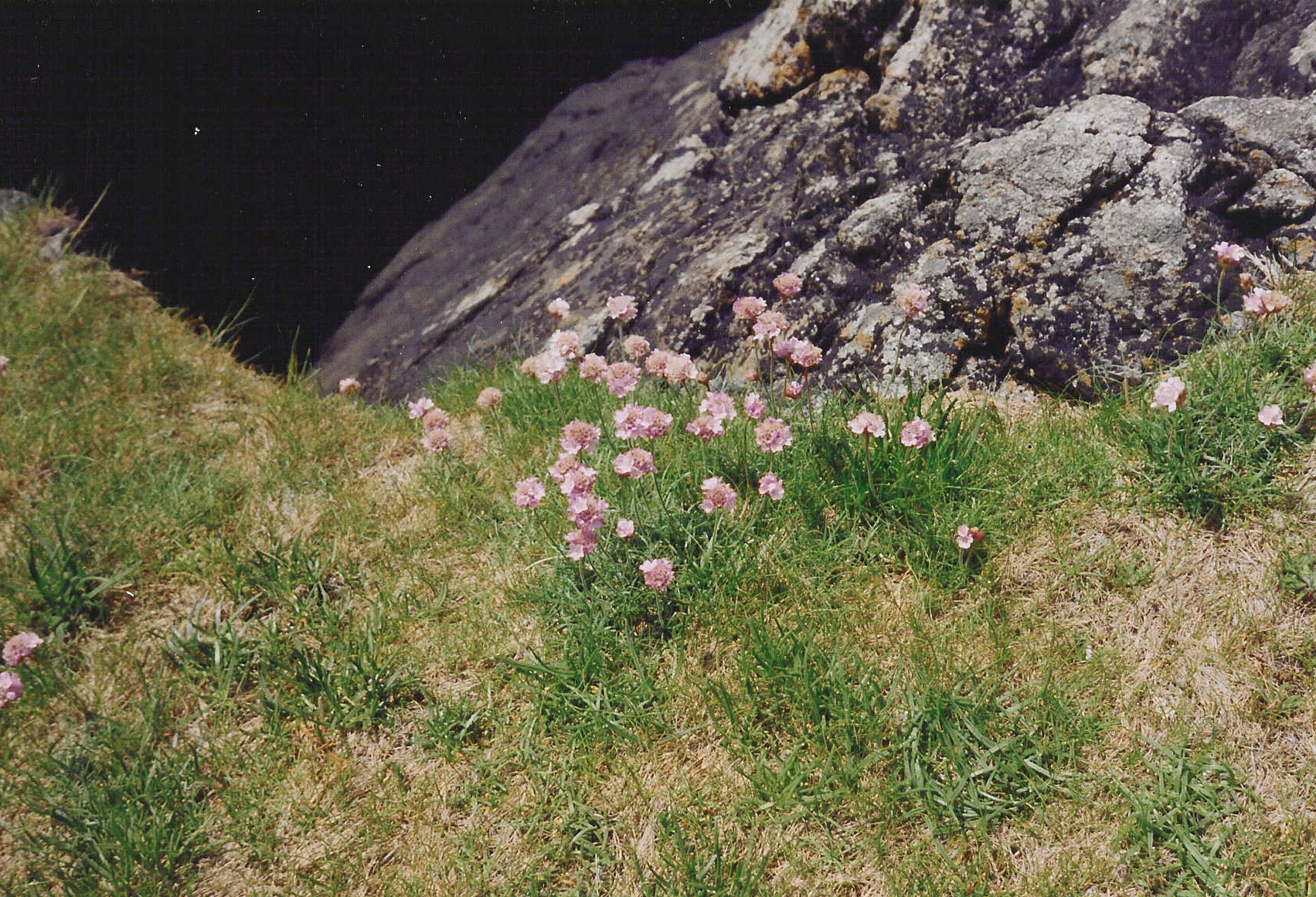
‘Barr a’ chinn’ (top of the head) was a common disease affecting children on Tiree, although not found elsewhere, and was usually caused by a fright. The child would become pale, listless and lose his or her appetite. It was said the condition was caused by the descent of two bones in the roof of the mouth.
There were two cures, physical and herbal. In the physical cure, the healer’s index and middle finger or thumb were pressed against the roof of the mouth, pushing the ‘bones’ back. This is remembered as being quite painful.
The herbal treatment used the plant sea pink, known locally as ‘barr a’ chinn’. This was collected on the day of the treatment, dried by the fire then put into a small cotton or linen bag which was sewn onto the patient’s vest. Both treatments were accompanied by a rhyme.
Colour photograph of sea pinks.
Clump of thrift or sea pink, known locally as bàrr a’ chinn, photographed by Dr John Holliday in 2000. It was used in a traditional cure for a disease affecting children on Tiree, also known as bàrr a’ chinn, which was not found elsewhere. The child would become pale, listless and lose their appetite, usually after a fright. It was believed that the condition was caused by the descent of two bones in the roof of the mouth.
Composition `The History of Tiree`s Public Halls` by Dr John Holliday.
Tiree`s public halls from WWII to 2000.
Composition `A Brief History of Light` by Dr John Holliday.
The history of lighting in Tiree from the end of the 19th century to 2002.