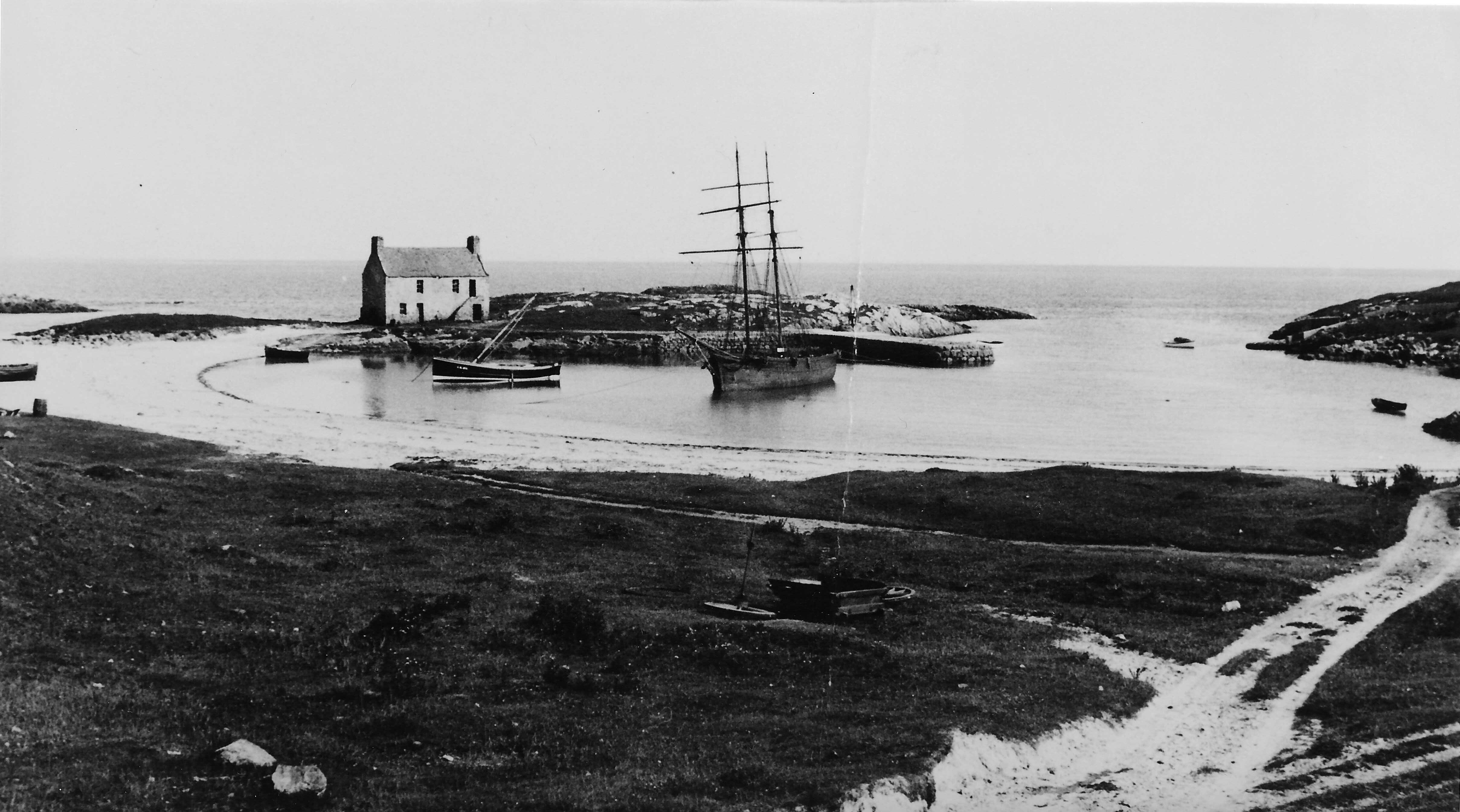
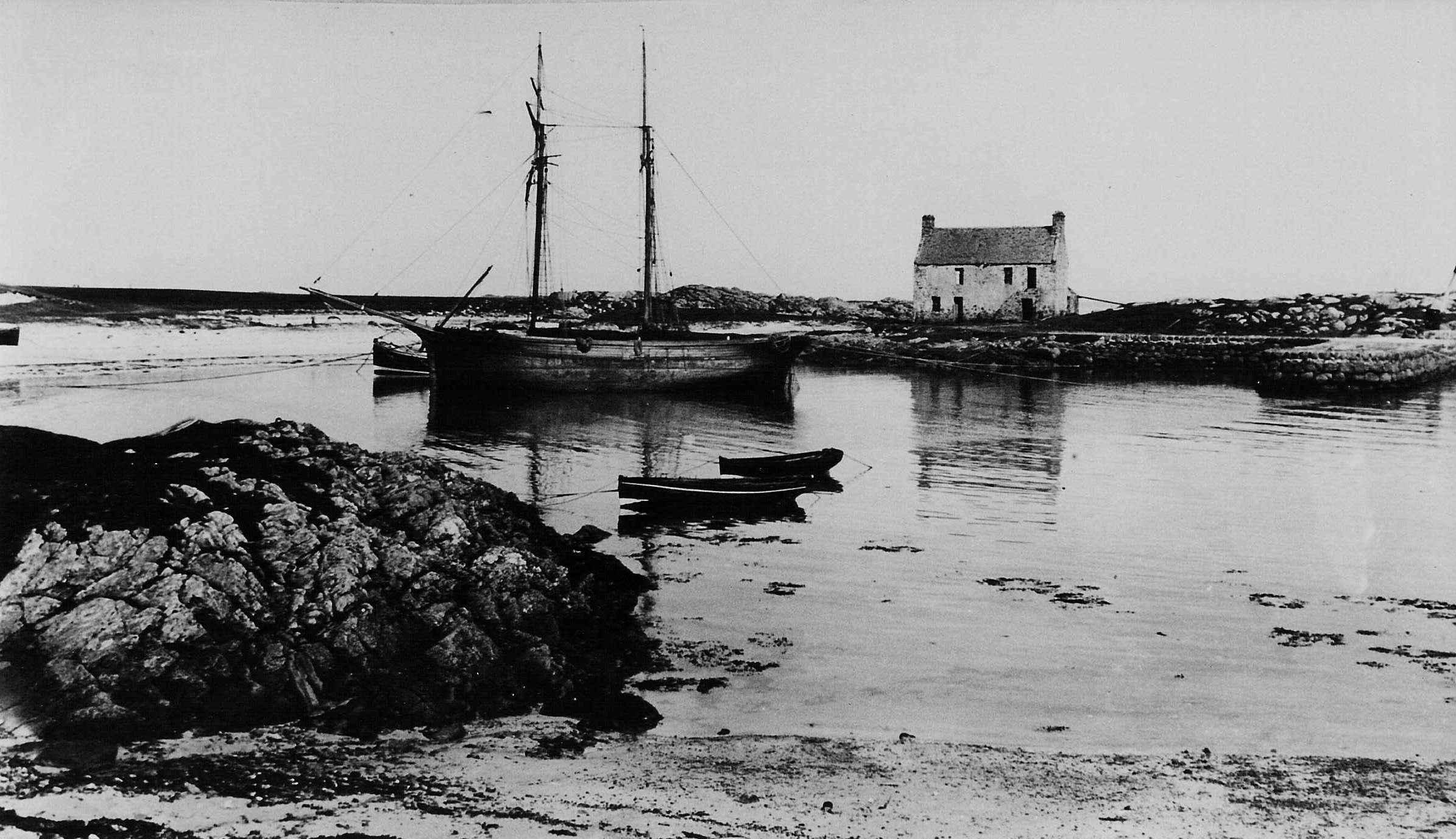
Scarinish harbour with the Mary Stewart, probably taken in the 1930s. The building in the background was originally built as a church, then used intermittently as a prison and latterly as a store by the owners of the Mary Stewart. It was pulled down to make roads during World War II.
The ‘Mary Stewart’ in Scarinish harbour in the 1930s
Photograph of the schooner ‘Mary Stewart’ in Scarinish harbour in the 1930s.
Courtesy of Mrs Netta Martin
Taken in the early 1930s, this view of Scarinish harbour shows the topsail schooner ‘Mary Stewart’ in her final resting place. For the previous thirty years she had traded up and down the west coast carrying coal and other cargo.
Also anchored in the harbour are two lobster boats. Commercial lobster fishing began on Tiree after 1880 when the railway to Oban was opened, allowing shellfish to be sent live to the London markets for the first time.
Said to have been originally built as a church, the building in the background was used as a store by the owners of the ‘Mary Stewart’. It was pulled down to make the road to the pier during World War II.
Black and white photograph of Scarinish harbour.
Scarinish harbour with the Mary Stewart, probably taken in the 1930s. The building in the background was originally built as a church, then used intermittently as a prison and latterly as a store by the owners of the Mary Stewart. It was pulled down to make roads during World War II.
Photograph of Calum MacLean, Hugh MacArthur and Peter Anderson outside the general store in Scarinish in 1910.
Courtesy of Mr Angus MacLean
Calum MacLean, Hugh MacArthur and Peter Anderson are pictured in 1910 outside the shop in Scarinish owned and run by Hugh and his brother Dan. As well as a general store, the building contained a Post Office and a hardware department upstairs
Calum MacLean (Calum Bùidsear) from Moss opened a butcher’s shop in Scarinish in 1930s on a site previously housing a baker and cobbler. The business was taken over by Donald and Nan MacLean in 1953.
Peter Anderson came to Tiree in 1886 as the island’s first gamekeeper. A keen ornithologist, he published ‘The Birds of the Island of Tiree’ in ‘The Scottish Naturalist’ in 1913
Black and white photograph of Scarinish shop in 1910.
Scarinish shop, 1910. L-R: Calum MacLean (butcher in Scarinish), Hugh MacArthur (partner in shop), Peter Anderson (gamekeeper). (Original photograph 1997.178.1)
Photograph of D. & H. MacArthur’s shop in Scarinish at the beginning of the 20th century.
Courtesy of Mrs Flora MacKinnon
Situated in Scarinish close to the ferry terminal, D. & H. MacArthur’s was the main shop on the island. It comprised a general store, a Post Office and a hardware department upstairs. The MacArthur family lived on the top floor.
The lean-to structure on the left is Taigh an t-Sàil where preserving salt was stored. Salted meat or fish would be packed in large barrels similar to those in the foreground. The wicker baskets to the left of the main doorway were used to import pan loaves from Glasgow.
There was no running water in the building but a well and pump outside. In 1948 disaster struck when a fire which began in the back paraffin store destroyed the shop. A new Co-operative store was built on the same site.
Black and white photograph of D & H MacArthur`s general store in Scarinish taken in the 1930s.
Situated in Scarinish close to the ferry terminal, D & H MacArthur’s was the main shop on the island. It comprised a general store, a Post Office and a hardware department upstairs. The MacArthur family lived on the top floor. The lean-to structure on the left is Taigh an t-Sàil where preserving salt was stored. Salted meat or fish would be packed in large barrels similar to those in the foreground. The wicker baskets to the left of the main doorway were used to import pan loaves from Glasgow. The building burned down during World War II and a new Co-operative store built on the same site.