


Photograph of houses on the shore at Scarinish harbour, 1947
Black & white photograph of house and fishing boat on the shore in Scarinish harbour in 1947, with a motor bike in the foreground. (original stored on CD in filing cabinet 10 drawer 1)


Photograph of houses on the shore at Scarinish harbour, 1947
Black & white photograph of house and fishing boat on the shore in Scarinish harbour in 1947, with a motor bike in the foreground. (original stored on CD in filing cabinet 10 drawer 1)
Photograph of Scarinish Harbour 1947
Black & white photograph of Scarinish Harbour from the air in 1947, probably taken from the platform of one of the five communications towers present at the time. The Mary Stewart is on the left. Note the lack of any building behind the pier. (original stored on CD in filing cabinet 10 drawer 1)

Photograph of Scarinish Harbour, 1947
Black & white photograph of Scarinish harbour in 1947 with the hotel on the left, the Mary Stewart on the right, and five Emergency Wireless Telegraphy Service communications towers in the background. (original stored on CD in filing cabinet 10 drawer 1)

Postcard to Bob Petrie, Scarinish Hotel, 1975
Handwritten letter on a blank postcard to Bob Petrie, owner of the Scarinish Hotel, on 15th Jan. 1975, from Duncan M Mellis, regarding an enclosed old postcard of a line drawing of the hotel around 1906 (photo K2).
Photograph of Scarinish Harbour and pier building ca 1930
Sepia photograph from a postcard of Scarinish Harbour around 1930, showing the ship the Mary Stewart on the left and a smaller ship tied up loading kelp from horse-drawn carts. The harbour building/office/store, now gone, is on the right.

Photograph of the coal ship Loch Iorsa aground in Arinagour harbour in 1920
Black & white photograph of the ship Loch Iorsa aground on rocks in Arinagour harbour, Coll, in 1920. Her cargo of coal for the island is being transferred to the other ship. The small ‘white’ shed to the right of the boats, built on stilts close to the shore, was `the post office above the waves` and built for Robert Sturgeon, Dalbeattie, who also established a fish buying and processing unit. Tiree folk traded with Robert Sturgeon. See also 2013.138.2 by Robert Sturgeon.

Photograph of ruined jetties in Fisgary Bay, Coll, in 2012.
Colour photograph of the ruins of two jetties in Fisgary Bay, Coll, taken in 2012, with an inset map showing their location. “The jetties were built to aid the loading of peat onto Tiree boats. Fisgary Bay is the nearest sheltered bay to the moss, although it is tidal as the photo shows. The two jetties are at the head of the bay, as close as possible it seems for the transport of the peat. Betty MacDougall (deceased Coll historian) wrote many years ago: “As the road rises to Aondairigh, a splendid view opens up seaward. As we proceed towards Loch Ronard, the village peat banks are on both sides of the road, few of them worked nowadays. There is no peat on Tiree, so at one time the men from that island used to come to Coll to cut their fuel and an area of moorland to the left of the road is still called the Tireemen`s Moss.””

Additional information provided by James Hill, Coll, May 2016: “Fiskary farm near the piers that were for the ponies carrying the peat to unload into the vessels was a subsistence farm and some associated structures on top of the hill were undoubtedly for storing peat and sheltering the peat cutters. The other ports were at Coalas en Eilean and Arinthluic close by that received peat from Tiree Mans Moss. The origin of the name of Fiskary Bay was part Norse and Gaelic. “Fisk” is fish in Norse, and “Kary” (“Caraigh”) is from the Gaelic meaning a wall in the sea i.e., “a Fish trap” that still exists but has been broken down to allow vessels to enter and leave the bay. It was Irish Gaelic that was spoken here. Fiskary Bay was also a Mesolithic fishing camp site that is dated to 9300 years BP but was probably earlier.”
Photograph of boats tied up at Scarinish Harbour around 1950.
Black & white photograph of three coal puffers (?) tied up at Scarinish Harbour around 1950.

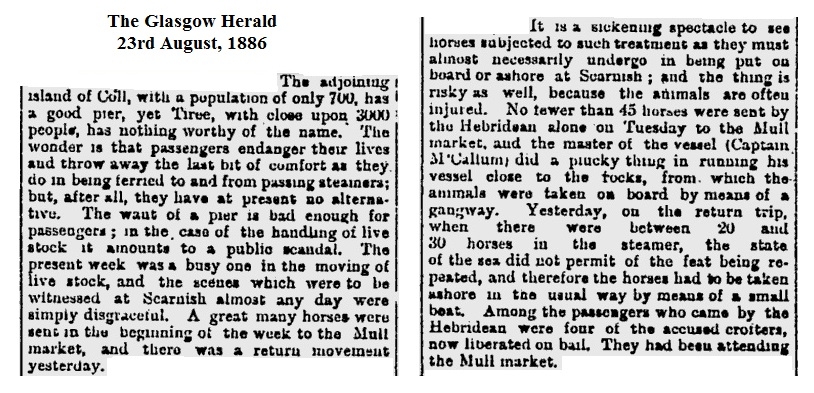
Newspaper article about the transfer of livestock between Tiree and ferry in 1886
Printed scan of an article from The Glasgow Herald dated 1886, about the dangerous method of transferring livestock, particularly horses, between Tiree and the ferry SS Hebridean. Article also mentions four of the imprisoned crofters of the Land Agitation liberated on bail.
Tiree Memories 2014 calendar by Alec Walker
Collection of colour and black & white photographs of old Tiree made into a calendar for 2014. Images include scything at Kilmoluaig, Balemartine PO in the early 1900s, Island House in 1924, drawing of Tug o` War in the late 1800s, Malcolm MacArthur at the reins of his grocers cart, Scarinish harbour 1900, Tiree Pipe Band 1977, Tug o` War 1979, milk delivered in old whisky bottles, coal puffer at Scarinish harbour, thatched house 1921, plane Britee-Norman Trislander 1979, ferry `Columba` in 1970s.