Record Type: review

2008.70.1

Colour photograph of the emigrants` stone at Druimbhuidhe.

The Emigrants’ Stone at Druimbhuidhe on the road between Heylipol and Cornaig, photographed by John Holliday in 2006. The day before emigrating, Iain Mòr Mairi Lachainn and Dòmhnall Mòr, both from Cornaig, were walking home after receiving their passage from Island House. One of them said to the other, “Well, we’ll be away from here and we’ll soon be forgotten.” And the other one said, “Let’s do something that they’ll remember us by,” so they rolled the boulder over on its side.

m194.jpg

2008.25.6

Colour photograph of decorated bone combs from the broch at Vaul in the Hunterian Museum in Glasgow.

Decorated Viking bone combs from the broch at Vaul photographed in the Hunterian Museum in May 2006.

k117.jpg

2007.126.5

John MacPhaden at the cheese factory in Kenyon Township in 1900

Photograph of John MacPhaden at the cheese factory in Kenyon Township, Glengarry, Ontario in 1900.

m118.jpg

Courtesy of Mrs Glenda Franklin

Alexander MacPhaden was born in Caoles in 1790, the son of Charles MacPhaden of Croish and his wife Christy MacPhail. Alexander emigrated to Ontario, Canada at the age of sixteen. He settled in Indian Lands, Kenyon Township in Glengarry County where he established a mixed dairy farm.

Alexander married Ann (or Jannet) MacIsaac MacDonald and the couple had at least eight children. Their son John (1839-1920) inherited the farm. Every day they took their milk to the cheese factory in Kenyon Township, pictured here in 1900.

John is the white-haired man in the back row. His two youngest sons are in the middle of the front row: the smallest boy is Charles and left of him is his brother John. John senior was a friend of the Indians who taught him to make medicine using plants and bark. He was also a soothsayer and in great demand for house parties.

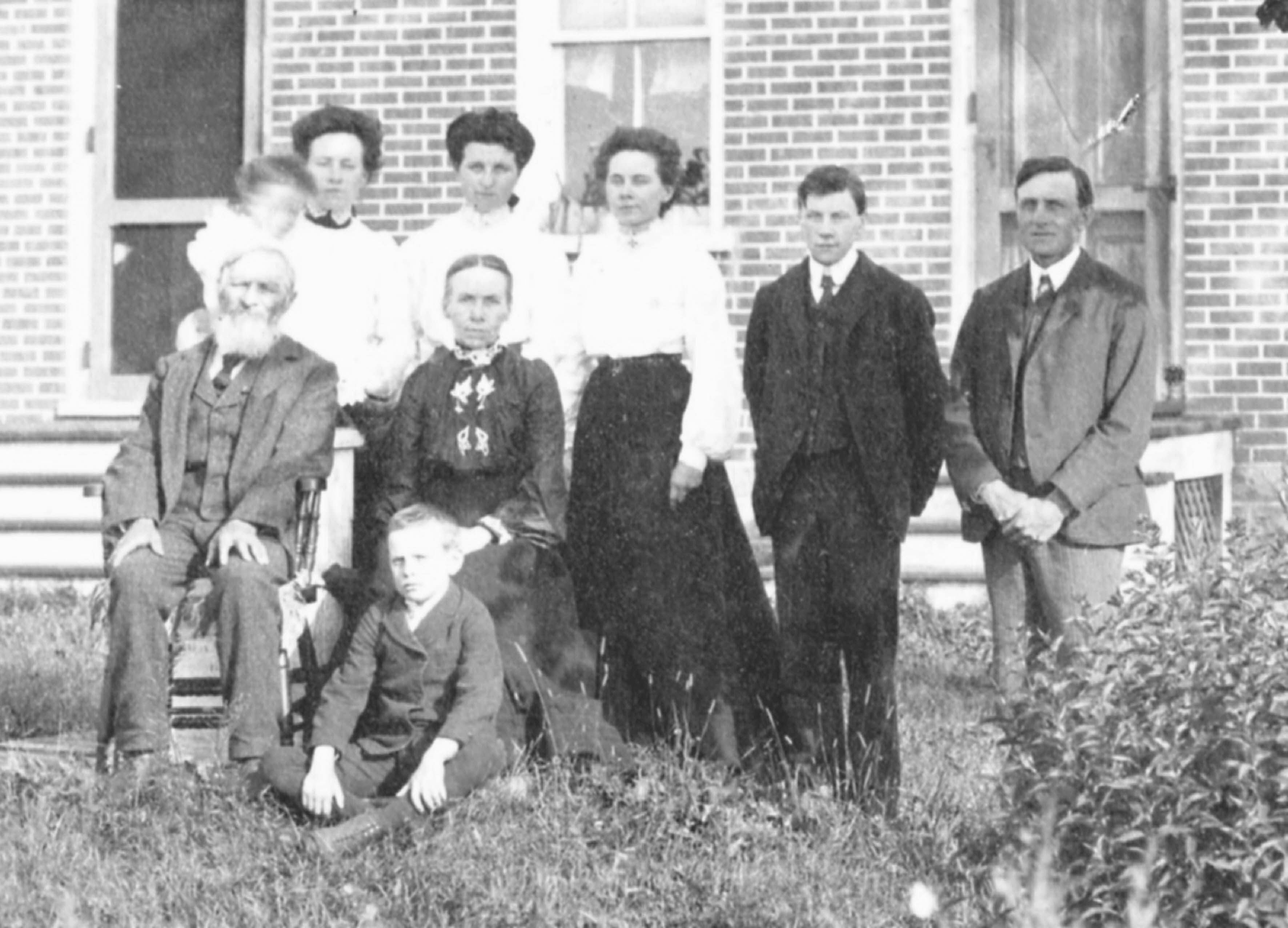
Black and white photograph of John MacPhadden with his family in Kenyon Township, Ontario in 1904.

The McPhadden homestead in Kenyon Township, Glengarry County, Ontario in 1904.
L-R: (seated) John McPhadden (1839-1920), his wife Mary Morrison (1852-1932) with their youngest son Charles, (standing) their daughter Isabella McPhadden McLaurin holding her son Houston; cousin Margaret Morrison, Isabella’s sister Hattie and brothers John and Alexander.

2007.126.3

Black and white photograph of Neil MacPhaiden of Salum with his seven children.

Neil MacPhaiden (centre front) with his five sons – Malcolm, Donald, Neil, Alexander and Charles – and two daughters – Catherine (left) and Mary Anne (right). The sisters married brothers Thomas and William Purvis.
Neil was born in 1807, the son of Donald MacPhaiden of Salum and his wife Catherine MacNaughton. The family emigrated to Canada in 1821 and settled in Brock Township Ontario. Neil married Mary MacLean who died in 1851. Neil himself died in 1881 and he and his wife are buried in the Old Scotch Cemetery in Brock.

m116.jpg

2007.125.1

Maraekakaho station

Photograph of Maraekakaho station at Hawke’s Bay in New Zealand.

m100.jpg

Courtesy of Mrs Ann MacPhee

Born in Kilmoluaig in 1820, Donald MacLean emigrated from Tiree aged eighteen. After a brief stay in Australia he moved to New Zealand where he became a fluent Maori speaker. The colony’s governor made him Protector of the Maoris around New Plymouth.

In 1844 he successfully defused a confrontation between Maoris and British settlers over disputed land. He travelled hundreds of miles on foot through scrub and along the coast by canoe, negotiating land sales and calming the simmering feuds between Maori tribes.

He bought 30,000 acres of rough land at Hawke’s Bay in 1855 where he established Maraekakaho station. In 1869 he became Minister of Native Affairs and also Minister of Defence. After his death in 1877, an old Maori chief wrote that MacLean had ‘spread the sleeping mat of peace for the tribes of the island.’

Black and white photograph of Mararekakaho station.

Mararekakaho station at Hawke`s Bay, New Zealand, established by Sir Donald MacLean.

2007.123.1

Otter at Gott Bay

Photograph of an otter at Gott Bay in April 2007.

l115.jpg

Courtesy of Mrs Carole Russell

Paul and Grace Yoxon of the International Otter Survival Fund based in Skye conducted an otter survey of Tiree for a week in August 2003. The coastline was mapped for secondary evidence of otters: spraints (droppings), sprainting points, freshwater pools, lie ups and holts (dens).

Five otters were sighted during the survey and nine major holts found. From this data, the number of otters resident on Tiree was estimated to be between six and eight. From analysis of the spraints, their diet consisted mainly of marine fish supplemented with hare.

While on holiday in April 2007, Carole Russell took this photograph of an otter on Gott Bay. The otter appeared from the direction of Soa, swiftly made his way along the waterline then disappeared inland.

Colour photograph of an otter on Gott Bay.

An otter on Gott Bay, photographed one eveing in April 2007.

2007.122.7

Rescued airmen at Tiree pier in 1944

Photograph of rescued airmen at Tiree pier in 1944.

l195.jpg

Courtesy of Mr Geoff Pringle

On 21 November 1944, one of starboard engines of Halifax LL510 from RAF Squadron 518 caught fire shortly after takeoff from Tiree airfield on weather reconnaissance duties. The flames were so intense the skipper decided to ditch in the Atlantic rather than risk returning to base.

Despite a thirty foot swell, the aircraft was safely ditched and the nine crewmen clambered aboard the inflatable dinghy with only minor scratches. To add to their danger, the water surrounding the Halifax was a sea of petrol, in the middle of which a fuel tank was bobbing about with flames issuing from a hole.

An Air-sea Rescue aircraft from Tiree dropped a second dinghy, then HMS ‘Flanders’ arrived to pick up the very much relieved airmen. They were given hot food, dry clothes and liberal amounts of Navy rum. The photograph pictures the crew safely back on Gott Bay pier.

Black and white photograph of the rescued aircrew of Halifax at Tiree pier.

The rescued aircrew of Halifax  from RAF Squadron 518 standing at Tiree pier in November 1944. Far left: F/Sgt Ozzie Ozaist (Met Air Obs, Polish); forth from left: Flt Lt Freddy Green.

2007.121.1

Neil Brown and his wife Sarah Henderson in 1889

Photograph of Neil Brown and his wife Sarah Henderson in 1889.

l188.jpg

Courtesy of Mrs Isabelle Carter

Neil Brown, who was born in Heylipol in 1819, emigrated to Canada with his twin brother Donald and five sisters in the late 1840s. Donald became ill, probably with ‘ship fever’ (typhus transmitted by body lice), and died on their arrival in Port Whitby, Ontario.

In 1858 Neil married Sarah Henderson from Nova Scotia. The couple had twelve children over the next nineteen years, including one set of twins: Mary (1859), Janet (1861), Katherine (1863), Margaret (1864), Donald (1866), Flora (1868), Sarah Ann (1870), Isabelle (1874,) Angus (1875) Christena and Phemma (1876), and John (1877). Donald, Phemma and John died before the age of four.

In common with many Scottish emigrants in the 19th century, the couple were deeply religious. Worship was held every day in their home. Sarah read the scripture then Neil led in prayer using the Gaelic tongue.

Black and white photograph of Neil Brown and his wife Sarah Henderson in 1889.

Neil Brown (1819-1905) and his wife Sarah Henderson (1835-1922) of Egmondville, Ontario in May 1889. Neil, who was born in Heylipol in 1819, was the son of Angus Brown and Mary MacArthur. He, his twin brother and five sisters emigrated to Canada with his twin brother Donald and five sisters in the late 1840s. Donald became ill, probably with `ship fever` (typhus transmitted by body lice), and died on their arrival in Port Whitby, Ontario. In 1858 Neil married Sarah Henderson from Nova Scotia. The couple had twelve children over the next nineteen years, including one set of twins. They were deeply religious and worship was held every day in their home. Sarah read the scripture then Neil led prayers in Gaelic.