


Colour photograph of the interior of Tiree Met Office.
The interior of Tiree Met Office.


Colour photograph of the interior of Tiree Met Office.
The interior of Tiree Met Office.
Colour photograph of the interior of Tiree Met Office.
The interior of Tiree Met Office.

Colour photograph of the interior of Tiree Met Office.
The interior of Tiree Met Office.

Colour photograph of the interior of Tiree Met Office.
The interior of Tiree Met Office.

Colour photograph of the interior of Tiree Met Office.
The interior of Tiree Met Office.

Tùr Mhic Chaluim at Kilkenneth
Photograph of Tùr Mhic Chaluim at Kilkenneth in 2001
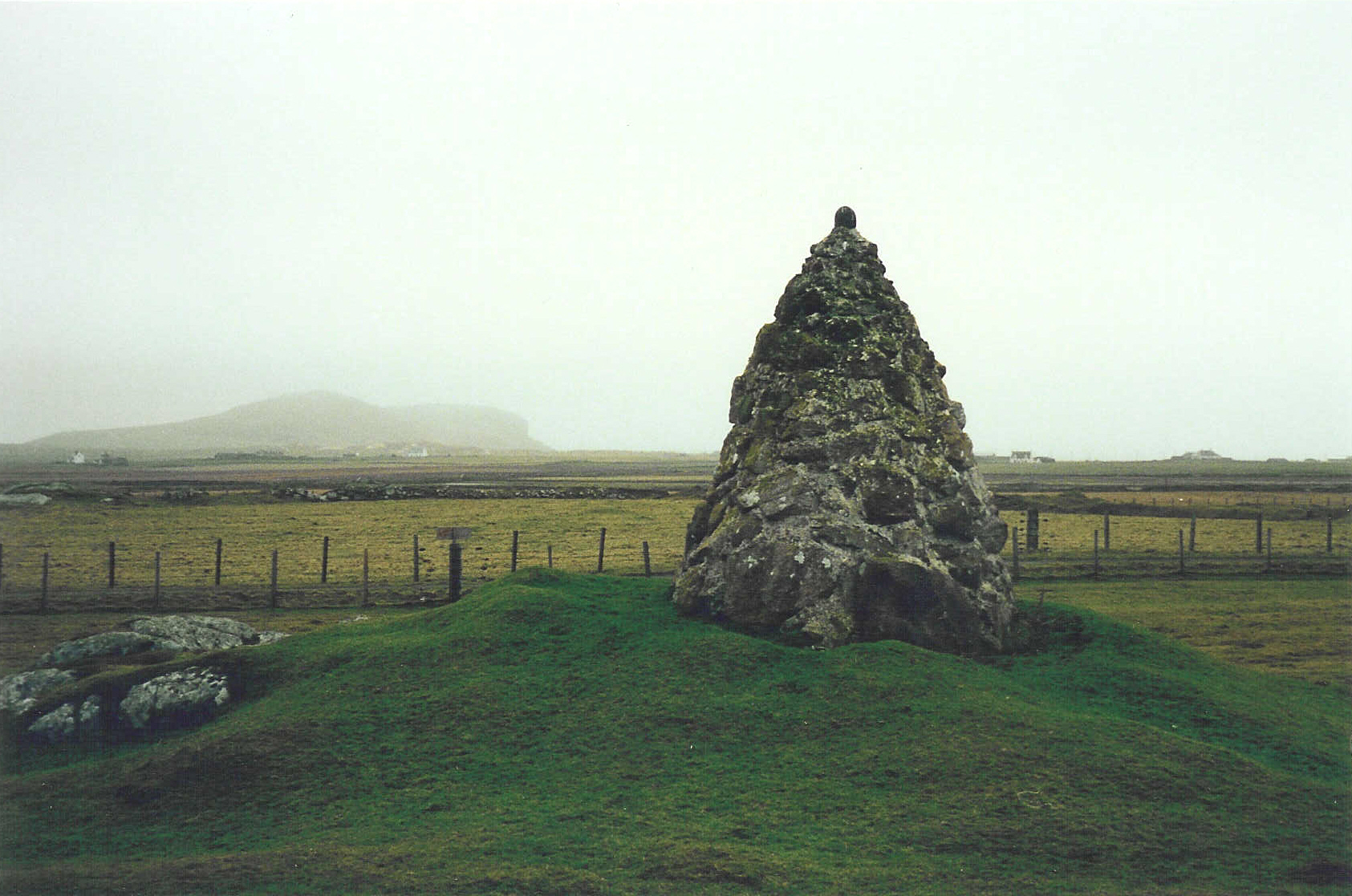
Born in Argyll in 1849, the Reverend Donald MacCallum was radicalised by what he saw of the Clearances and became the crofters’ and cottars’ champion. This was a rare stand for a minister at that time dependant as they were on their landlord for manse, glebe and living.
He served in Loch Geàrr, Arisaig and Skye, where he became the only Highland minister of that era to be imprisoned for his political beliefs. He came to Tiree in 1887 but was forced out after 18 months by the Argyll family who refused to support him.
The crofters of Tiree erected the cairn in his honour. The inscription read: ‘Tùr McCallum, 1st July 1889. Bas no Buaidh. Death or Victory.’
Colour photograph of Tur Mhic Chaluim in Kilkenneth in 2001.
Tur Mhic Chaluim in Kilkenneth photographed in February 2001 by Catriona Hunter. The memorial was erected in honour of the Reverend Donald MacCallum who was born in Argyll in 1849. He was radicalised by what he saw of the Clearances and became the crofters’ and cottars’ champion. This was a rare stand for a minister at that time dependant as they were on their landlord for manse, glebe and living. He served in Loch Geàrr, Arisaig and Skye (where he became the only Highland minister of that era to be imprisoned for his political beliefs), then came to Tiree in 1887. He was forced out after 18 months by the Argyll family who refused to support him. The inscription reads: ‘Tùr McCallum, 1st July 1889. Bas na Buaidh. Death or Victory.’
Dùn Mòr at Vaul in 2001
Photograph of the broch at Vaul in 2001.

Excavated by Dr Euan MacKie in the 1960s, the broch measures 9.2 metres in internal diameter with dry-stone walls up to 4.5 metres thick and was once probably 8 metres high. Built around the middle of the 1st century AD, the absence of a permanent central hearth suggests it was used originally as a temporary refuge.
The upper storeys of the broch were subsequently dismantled and a round-house, possibly an aisled wheel-house, may have been constructed in the interior. It housed a flourishing community engaged in mixed farming, iron-working and bronze-casting.
Radiocarbon dating of organic material indicates that the site was inhabited from the late 6th or 5th century BC to the 2nd or 3rd century AD, though perhaps not continuously.
Colour photograph of the interior of the Vaul broch in 2001.
The interior of the broch at Vaul photographed by Catriona Hunter in February 2001. Excavated by Dr Euan MacKie in the 1960s, the broch measures 9.2 m in internal diameter with dry-stone walls up to 4.5 m thick and once probably 8 m high. Built around the middle of the 1st century AD, the absence of a permanent central hearth suggests it was used originally as a temporary refuge. The upper storeys of the broch were subsequently dismantled and a round-house, possibly an aisled wheel-house, constructed in the interior. It housed a flourishing community engaged in mixed farming, iron-working and bronze-casting. Radiocarbon dating of organic material indicates that the site was inhabited from the late 6th or 5th century BC to the 2nd or 3rd century AD, though perhaps not continuously.
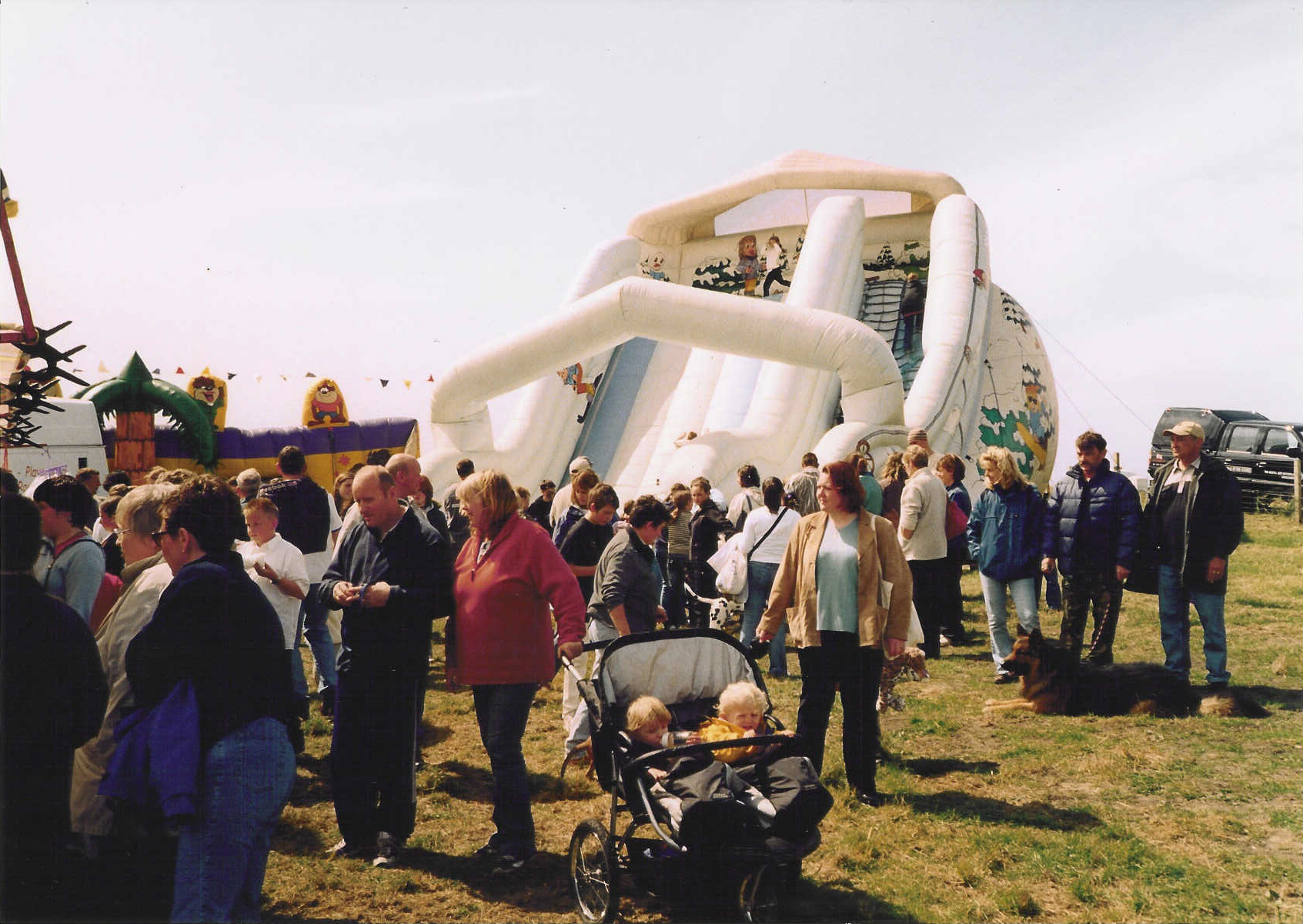
Colour photograph of the bouncy castle at the Tiree Show in July 2004.
The giant bouncy castle at Tiree Argricultural Show in July 2004. To the right of the pram is Dolina Campbell née MacKinnon of Baugh and on her right is Margaret Straker née Worsley of Crossapol.
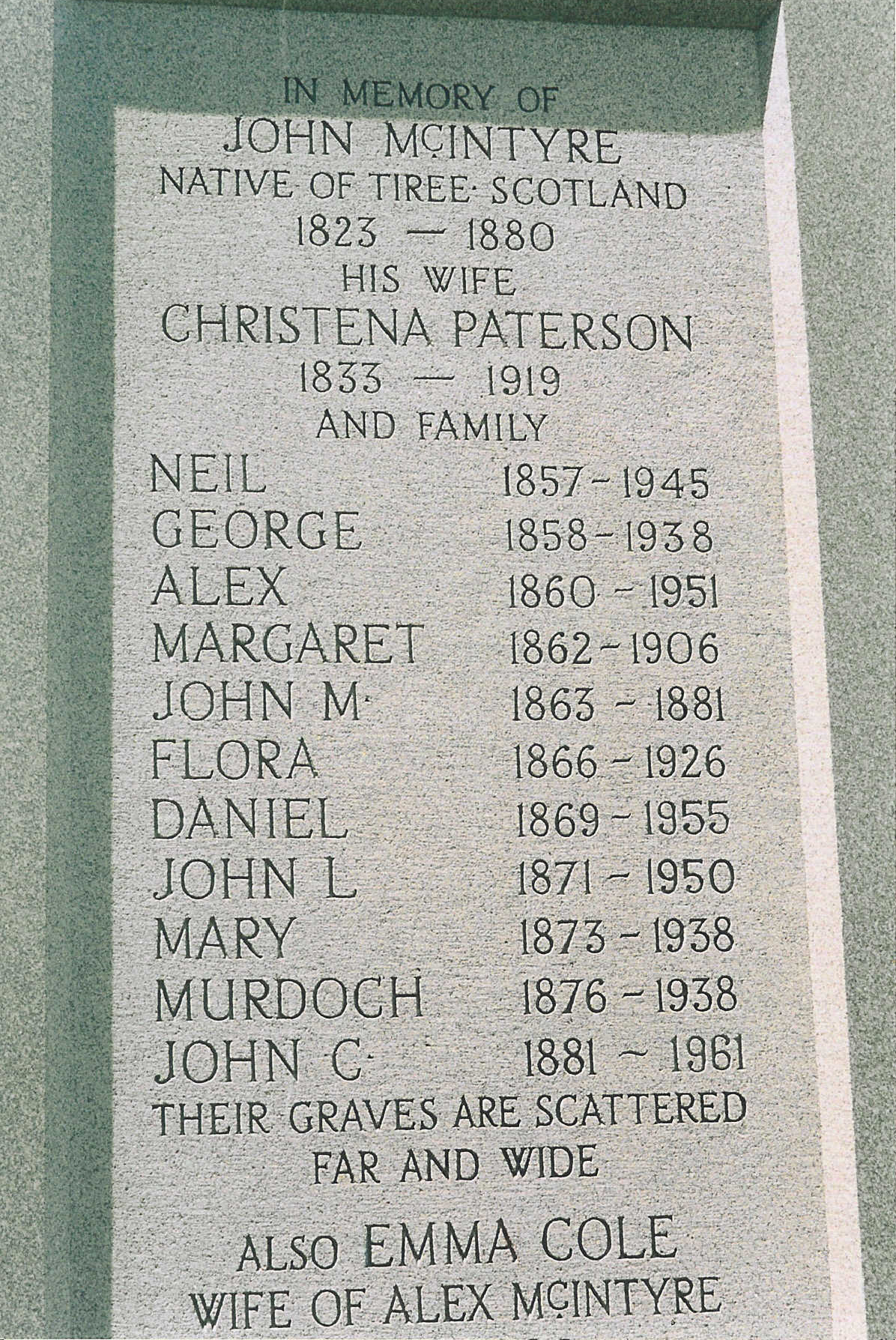
Colour photograph of the gravestone of John MacIntyre and his wife Christena Paterson.
Gravestone of John MacIntyre (1823-1880) from Tiree and his wife Christena Paterson (1833-1919) in Lovat Cemetery, Bruce Township, Ontario.
Colour photograph of the gravestone of Hugh MacDougall and his wife Mary MacFadyen.
Gravestone of Hugh MacDougall (1837-1925) and his wife Mary MacFadyen (1842-1921), both from Tiree, in Lovat Cemetery, Bruce Township, Ontario.
