


Photocopied extract `The history of the seaweed industry: the iodine industry` by Ernest Booth.
The history of the iodine industry and its medical applications.

Photocopied extract `The history of the seaweed industry: the iodine industry` by Ernest Booth.
The history of the iodine industry and its medical applications.
Photocopied article about the history of the seaweed industry by Ernest Booth.
Article about Edward Curtis-Stanford and the iodine industry.
Black and white postcard of kelp-burning at Kennavara.
Kelp-burning at Kennavara.

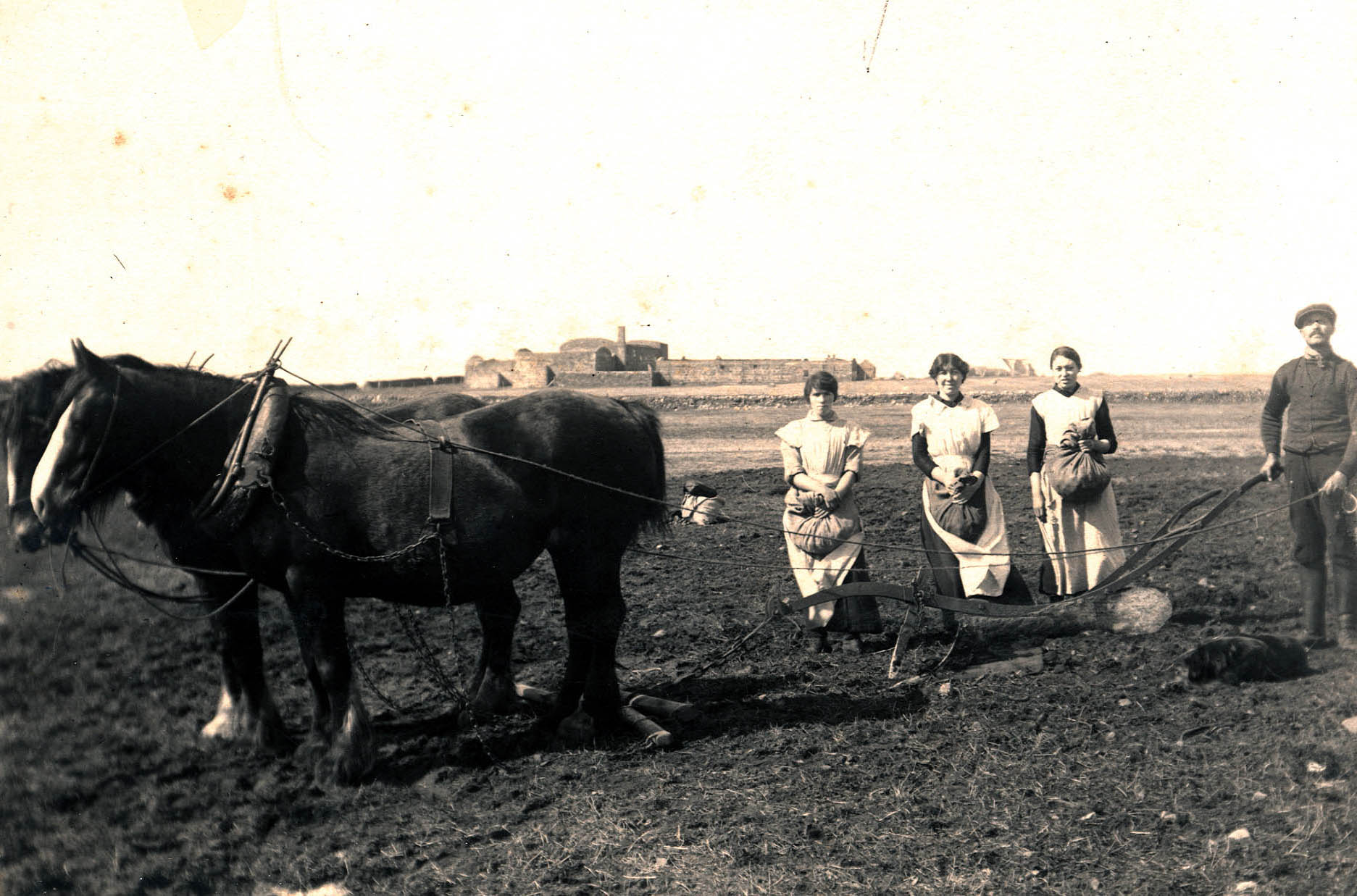
Planting potatoes at Middleton in the 1920s
Photograph of Alasdair MacDonald planting potatoes with Lizzie MacArthur, Effie and Mary Ann MacDonald at Middleton in the 1920s.
Courtesy of Mr Lachie MacDonald
Taken in the 1920s, the photograph illustrates a standard plough used to prepare the ground for sowing corn. Because of the fine sandy soil in most of Tiree, a ridger was not successful.
The women followed in the furrow planting potatoes from the supplies heaped in their sack aprons and the ploughman made a second furrow to cover them. This process was repeated leaving a 45 cm space between the planted furrows for the grubber.
The Middleton seaweed factory operated by the North British Chemical Company can be seen in the background. Known locally as the Glassary, it ceased operation in 1901 and was demolished during World War II.
Black and white photograph of Alasdair MacDonald planting potatoes at Middleton in the 1920s.
Planting potatoes at Middleton, with the Glessary (as it was known) in the backgound in the 1920s. L-R: Lizzie MacArthur, Middleton and Greenhill – aunt of John MacArthur, Middleton Farm; Effie MacDonald, married to the late Archie Walker, Coll and Kenovaay, Tiree – aunt of Lachie MacDonald , Middleton; Mary Ann MacDonald – aunt of Lachie MacDonald, Middleton; Alasdair MacDonald – father of Lachie MacDonald, Middleton. The photograph illustrates a standard plough used to prepare the ground for sowing corn. Because of the fine sandy soils in most of Tiree, a ridger was not successful. Instead, the standard plough was used and the women followed in the furrow with supplies of potatoes heaped in their sack aprons. The ploughman made a second furrow to cover the potatoes. The same process was repeated thus leaving an 18 inch (45cm) space between planted furrows to allow the grubber to be used.
The seaweed factory at Middleton
Photograph of the remains of the seaweed factory at Middleton.

Courtesy of Mr Donald MacKinnon
The kelp forests around Tiree are the fourth largest in Scottish waters. This abundance fuelled the seaweed industry on the island which, for a hundred years, produced alkali for soap and glass manufacture, and for bleaching linen.
Undercut by cheap foreign imports, the industry slumped from the 1830s until the 1860s when the North British Chemical Company appointed as manager a brilliant young chemist, Edward Curtis-Stanford. He arrived in Tiree in 1864 to supervise the building of the factory at Middleton, known locally as the Glassary.
Until 1901 the factory extracted iodine and alginates from the tangles, selling the residual charcoal as fertilizer and deodorants for earth closets, and using the gas produced by the process to light the buildings. Most of the factory was demolished in 1941 to provide the foundations of the runways built at the Reef for the RAF station.
Black and white photograph of the old seaweed factory at Middleton.
The old seaweed factory at Middleton in the early 20th century.
Photocopied letter by Edward Curtis Stanford written on 3/1/1864.
Account by Edward Curtis Stanford written on 3/1/1864 about the previous year on Tiree and the difficulties he experienced building the seaweed factory at Middleton.
Photocopied account of the discovery of alginic acid by Edward Curtis-Stanford.
Biography of Edward Curtis-Stanford, his discovery of alginic acid and an account of the processes used at the Middleton seaweed factory.
Photocopied papers by Edward Curtis-Stanford.
Front page of Stanford`s paper `On the Manufacture of Kelp` and various other handwritten pages about the uses of seaweed, costings, proposed plans for the factory and drying sheds and highland medicines using seaweed..
Photocopied biography of Edward Curtis-Stanford.
An account of the life and work of Edward Curtis-Stanford.
Photocopied extract from `The Clyde District of Dumbarton` by MacLeod in 1886.
Account of the North British Chemical Company`s works in Dumbarton which extracted the chemicals from the kelp charcoal produced in Tiree; photograph Curtis-Stanford with other Commissioners of the Burgh of Clydebank in 1886.