Photographs of the construction of the Ro-Ro linkspan on Gott pier in 1992.
Series of 24 colour photographs of the construction of the roll-on roll-off linkspan at Gott Bay pier in 1992, showing stages of progress and the huge crane floated in for the job. (see photos W21-W26 for similar)
Colour photograph of An Iodhlann building from the road, with new steps, handrail and sign, taken in spring 2012. (Original and four other copies in filing cabinet 9, drawer 4).
Photograph of the sunken `Loch Seaforth` with the `Claymore` and `Glencloy` in the background
Colour photograph of the ferry `Claymore` and cargo vessel `Glencloy` off Gott Bay pier with the sunken ferry `Loch Seaforth` in the foreground in 1973. Until the `Loch Seaforth` was refloated, passengers were transferred from/to the Claymore by motor launch. Cargo and livestock were transported on the smaller cargo ship `Glen Cloy` which could berth between the sunken ferry and the pier.
Photograph of the ferry `Claymore` with its tender alongside in 1973
Colour photograph of the ferry `Claymore` with its tender alongside. In 1973, the ferry `Loch Seaforth` sank next to Gott pier after hitting rocks in Gunna Sound. Until it was refloated, the `Claymore` could not berth alongside the pier and so passengers were transferred from/to the ferry by motor launch. Cargo and livestock was taken on the smaller cargo ship `Glencloy` which could berth between the sunken ferry and the pier.
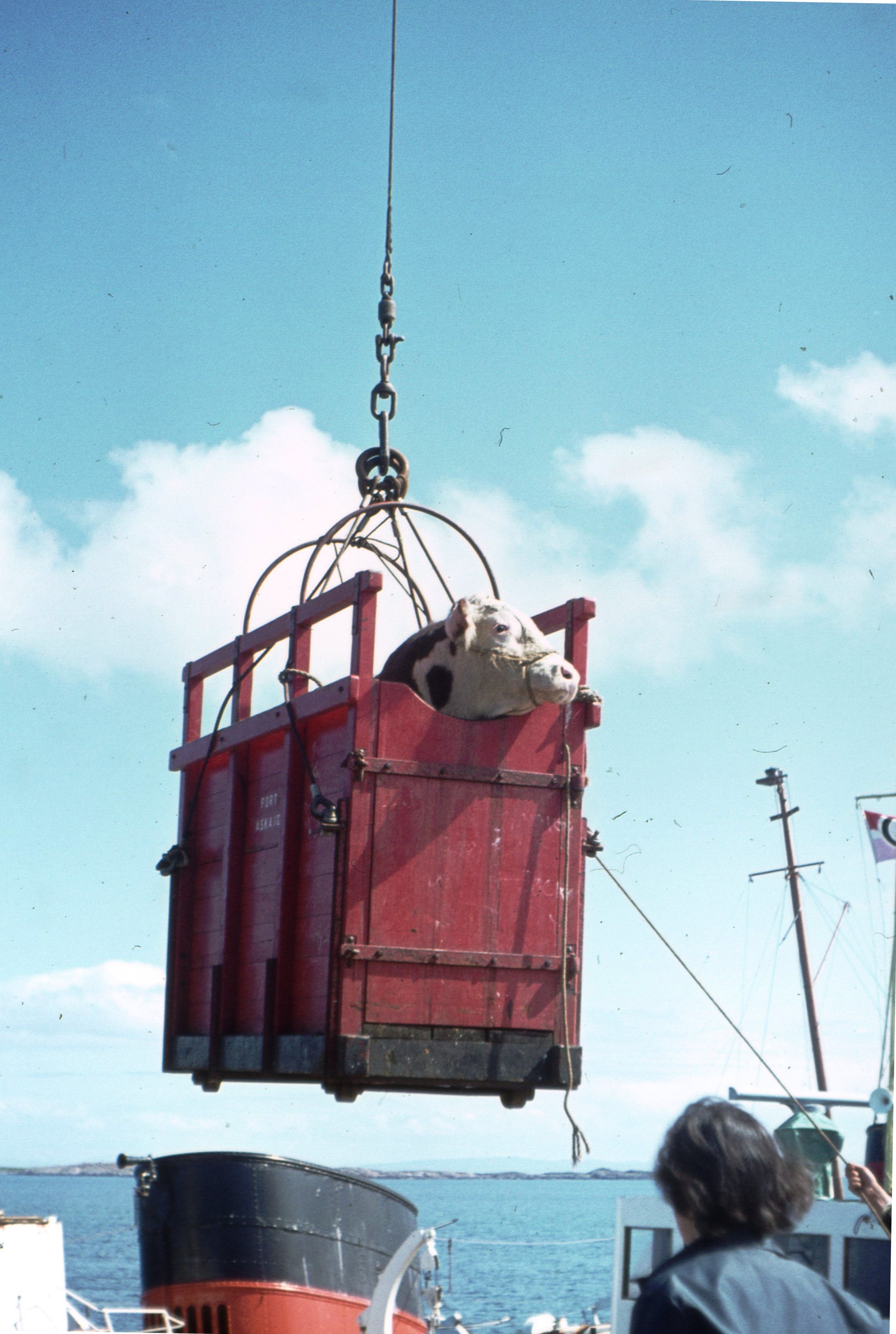
Photograph of a bull being loaded onto the `Glen Cloy`
Colour photograph of a bull in a crate being hoisted by crane from Gott pier to the cargo vessel `Glencloy` in 1973. The ferry could not berth alongside the pier at that time because of obstruction caused by the `Loch Seaforth` which had sunk alongside the pier as a result of hitting rocks in Gunna Sound.
Photograph of the `Claymore`s tender transferring passengers past the sunken `Loch Seaforth`
Colour photograph of the tender craft from the ferry `Claymore` passing the sunken `Loch Seaforth` on its way from Gott pier to the ferry with a load of passengers. When the `Loch Seaforth` sank by the pier in 1973, the Claymore could not berth alongside and so passengers had to be transferred between the ferry and pier by the Claymore`s tender.
Information about the flight crew of one of the mid-air collision Halifaxes
Printed email from Ken Organ about the flight crew of one of the RAF Halifax aircraft that crashed in mid-air over Tiree in 1944 with the loss of all crew`s lives. Ken` father was one of them.
15 August 2012: “I said I would inform you of the identity of the airmen on the photograph we looked at last week. From the original my father noted the airmen thus:- front row left to right: F/O “Harry” Oates, F/Lt “Bill” Kemp, F/O K W Organ, F/O “Johnny” Peterson; back row left to right: Sgt “Bill” Graham, Arthur Marshall, “Norm” Power, “Warny” Creswell.
I understand that my father’s crew in the accident on 16/8/1944 included six of the above, but not Kemp and Power. Instead of Kemp and Power there was P/O B W Smith and Sgt P G Smith. I do not know when or where the photograph was taken, but his diary notes he was posted to Tiree on 10th August 1944 (and the accident was six days later); prior to Tiree his diary notes he was at RAF Brawdy (in Pembrokeshire). Maybe the photograph was taken there and that he went with most of his crew to Tiree. I guess we’ll never know.”
Printed internet content about a flight officer`s experiences of service in 518 Squardon, RAF Tiree, during WWII, and how their operations were critical to finding the weather window for the D Day landings (copyright www.oldnautibits.com).