


Copied photograph of Canadian Premier Joe Clark as a baby with his father and grandfather.
Canadian Premier Joe Clark as a baby with his father and grandfather.


Copied photograph of Canadian Premier Joe Clark as a baby with his father and grandfather.
Canadian Premier Joe Clark as a baby with his father and grandfather.
Copied photograph of Canadian Premier Joe Clark campaigning with his mother and father.
Canadian Premier Joe Clark campaigning with his mother and father.

CD of image files and prints of various views of Tiree.
CD of image files and prints of various views of Tiree – Balephul, Island House, Earnal – taken by Claudia Ferguson-Smyth in 2006.
Copy of tintype photograph of Neil Cameron 1824-1909.
Neil Cameron (1824-1909) of Balevullin who emigrated to Canada on the `Charlotte` in 1849 with his widowed mother Flora MacFarlane Cameron and his brothers and sisters. He married Margaret Thornhill in 1857 and had five children: John, Robert, Margret Jane, Hugh and Flora. He moved to Michigan and then Minnesota where he took out American citizenship.

Copy of tintype photograph of Flora MacFarlane, wife of Hugh Cameron, with her grandchildren around 1873.
Flora MacFarlane, wife of Hugh Cameron of Balevullin, with her grandchildren Neal (b. 1867), Margaret Jane (b. 1861) and Isabella (b. 1869), taken around 1873. Born in 1795 in Kilkenneth, the daughter of Neil MacFarlane and Marion MacLean, Flora, then a widow, emigrated to Canada with four of her children on board the `Charlotte` in 1849. The family settled in Bruce County, Ontario.

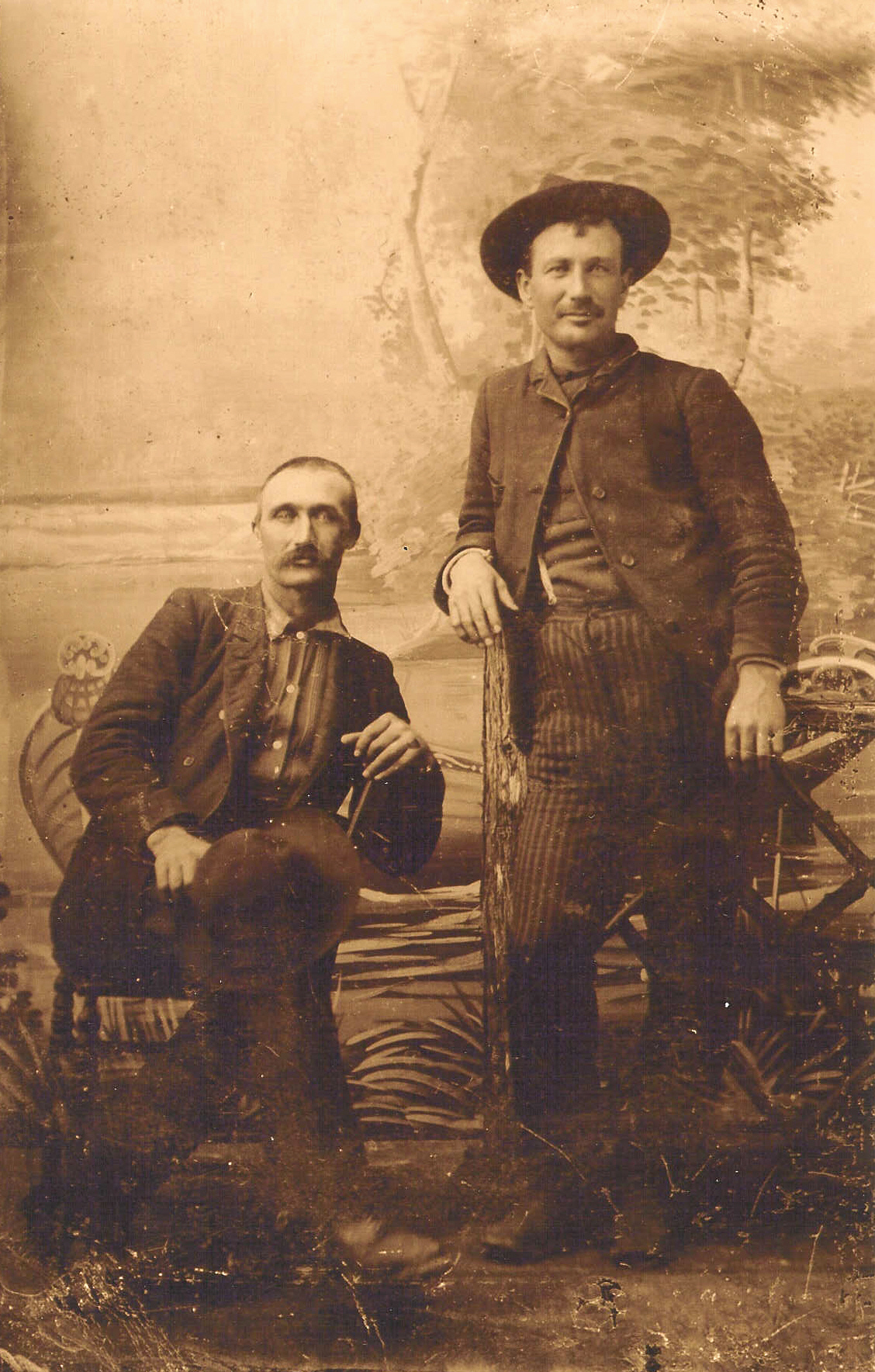
Copied tintype photograph of Neil Cameron (1824-1909).
Neil Cameron (1824-1909) of Balevullin on the right photographed in Canada in the early 1870s. He eventually settled in Minnesota.

Copied tintype photograph of Neil Cameron (1824-1909).
Neil Cameron (1824-1909) on the right photographed in Canada in the early 1870s.
Kincardine School in 1897
Photograph of School Section 11 in Kincardine Township, Ontario in 1897.

Courtesy of Mr Archie MacKinnon
This photograph of 1897 shows the sons and daughters of pioneers from Tiree in School Section 11 of Kincardine Township, Ontario. The wooden school behind them was built in 1871 on land donated by Archibald MacKinnon.
Archibald’s parents, Fingon MacKinnon and his wife Christena MacLean, emigrated from Salum to Canada in 1851 with their seven sons then aged between five and nineteen. Fingon first worked as a labourer in Brock Township where the youngest son died of typhoid in 1854. The family then moved to Kincardine Township and settled on Lot 29 Concession 11. Fingon died there in 1859.
By 1861 the family had cleared sixty of their hundred acres. Their crops included spring wheat, oats, potatoes and turnips and, as well as two oxen, they had three steers or heifers, four milk cows and seven pigs. They continued the Tiree tradition of combining farming and other trades, e.g. carpentry.
Printout of a black and white photograph of Kincardine township school in 1897.
The sons and daughters of Tiree pioneers at Kincardine Township school in 1897. The school was built on land donated by Archibald MacKinnon originally from Salum.
The mill lade at Cornaig
Photograph of the mill lade at Cornaig.

The mill at Cornaig was powered by water from Loch Bhasapol. Drainage into the loch from Kilmoluaig sliabh was controlled by the miller using a small dam. He could also control the level of the loch by using a sluice-gate at the top of the mill lade.
The water was led down a sluice to the vertical wheel, which was ‘breast-driven’, hitting the wheel halfway down. This was less efficient that an overshot wheel where the water hit the wheel higher up but was the best that could be achieved as the loch level is only slightly higher than the mill.
The amount of water hitting the wheel determined the speed at which it turned. The miller could vary this by raising or lowering a flap at the bottom of the lade, which directed more or less water on to the wheel.
Colour photograph of the mill lade at Cornaigmore.
The mill lade at Cornaigmore taken by Dr John Holliday in 2003.
Black and white photograph of a regatta around 1950.
Rowing in from a Tiree regatta around 1950. The boat furthest away is the `Mayflower`.
