The two men are building a corn stack or ‘mulan’ which will provide winter feeding for horses, cattle and hens and seed for spring sowing. In the background is a row of haystacks. Corn stacks were built with the heads of the sheaves to the centre so the finished stack contained a column of seed.
Four sheaves were placed upright in the centre with further sheaves added around the centre, working clockwise. The sheaves were always kept with the seed uppermost so any moisture would run away from it down the straw.
The diameter of the stack was carefully measured using a special rope, either six or seven fathoms long, marked with a knot at one end and a block at the other. The stack was re-measured every two rows to keep it straight. These traditional methods are still in use today by a few crofters on the island.
Black and white photograph of building a cornstack at Whitehouse.
The two men are building a corn stack which will provide winter feeding for horses, cattle and hens and seed for spring sowing. In the background is a row of haystacks. At harvest time, the cut corn would be bundled by hand into sheaves, six of which would be stood together to form stooks. When sufficiently dry, the stooks would be transported by horse and cart to the stackyard. Corn stacks were built with the heads of the sheaves to the centre so the finished stack contained a column of seed. These traditional methods are still in use today by a few crofters on the island.
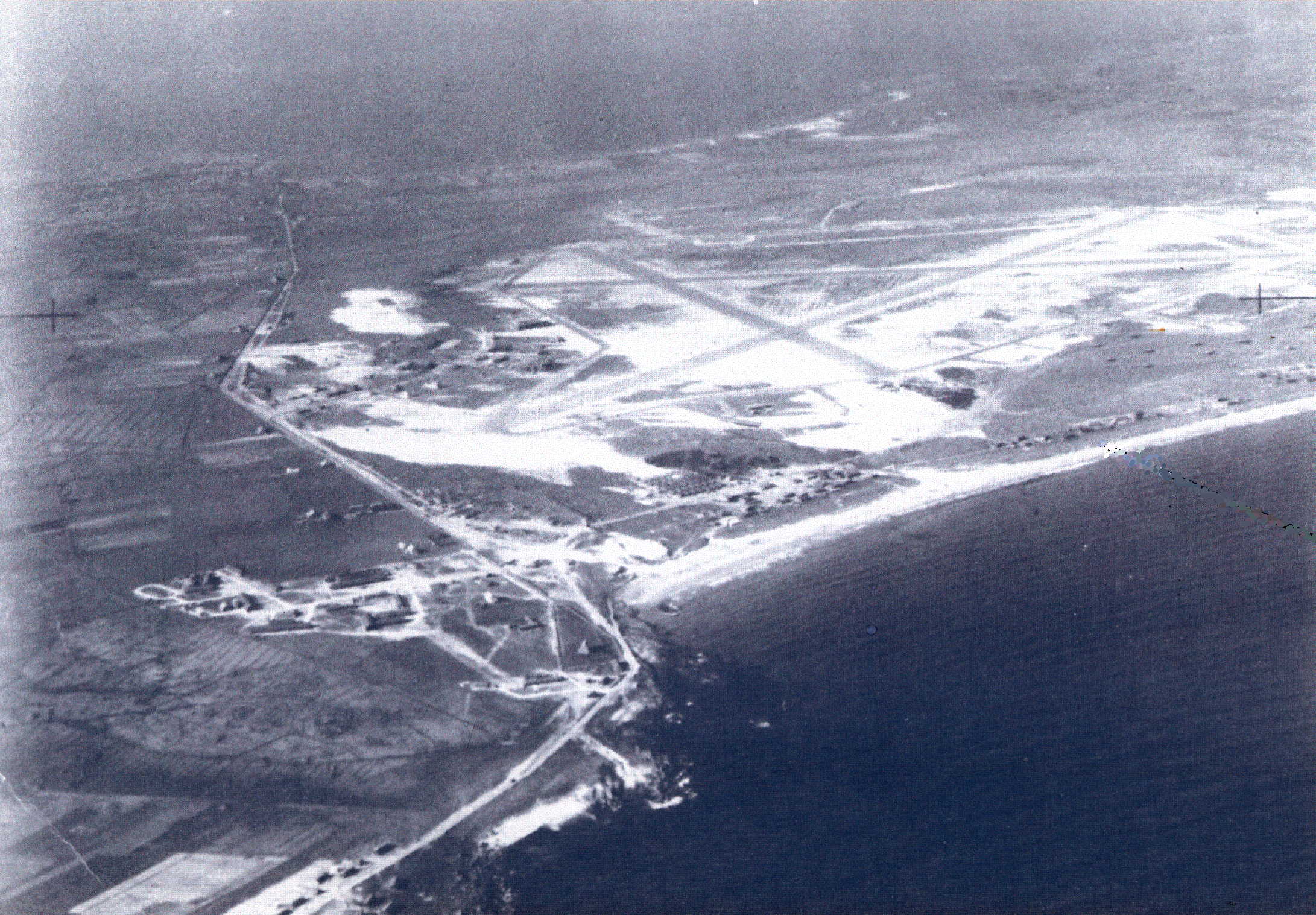
The origins of the Tiree airfield go back to 1934 when Midland and Scottish Airways selected a grass landing site on the Reef. A rental dispute delayed until 1937 the start of air services which continued to operate spasmodically during World War II.
The Reef was requisitioned by the Ministry of War in 1940 to provide air cover for the convoys routed from the North Sea to the Irish Channel. Contractors Melville, Dundas & Whitson and Tawse of Aberdeen were among those involved in building the airstrip, roads and living quarters for the RAF base.
Labourers were brought in from Ireland and the mainland, including prisoners from several Scottish jails. Quarries at Baugh and Balephetrish were blasted out and the ruins of the Glassary seaweed factory in Sandaig and the storehouse on Scarinish jetty were demolished and used as hardcore.
Aerial photograph of Tiree Aerodrome, 1944.
Aerial view of Tiree Aerodrome taken in 1944 showing erosion.
Magazine articles `Tiree Portfolio` and `Gott Bay Pier, Isle of Tiree` from Caledonian MacBrayne staff magazine `Brayne Waves`, 1997
(1) `Tiree Portfolio` was written with contributions from Hector MacPhail and records which boats served Tiree, their captains, cargo handling methods, and improvements at the Pier, (2) `Gott Bay Pier, Isle of Tiree` was written by Alexander MacArthur, (Balemartine) who worked on the SS Hebrides. He gives an account of cargo handling including cattle and vehicles.