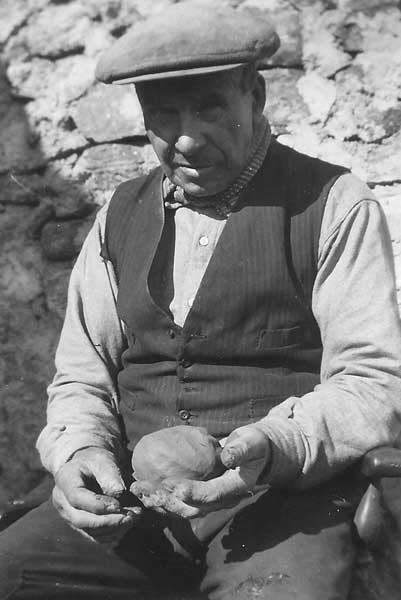
Black and white photograph of Hugh MacNeill of Balevullin in the early 1940s.
Hugh MacNeill of Balevullin demonstrates how his mother, Flora MacNeill, would make small clay pots known as craggans. Made by hand from local clay without the aid of a potter’s wheel, Tiree craggans were believed to have special curative properties, particularly in the case of consumption.
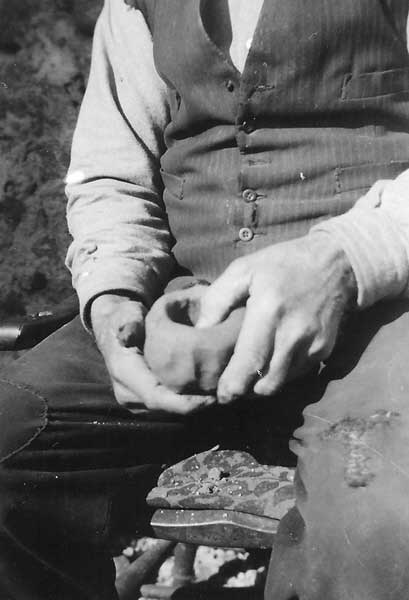
Black and white photograph of Hugh MacNeill of Balevullin in the early 1940s.
Hugh MacNeill of Balevullin demonstrates how his mother, Flora MacNeill, would make small clay pots known as craggans. Each township had its potter who was always a woman. Flora MacNeill of Balevullin, who died aged eighty in the 1920s, was the last known craggan-maker on Tiree.
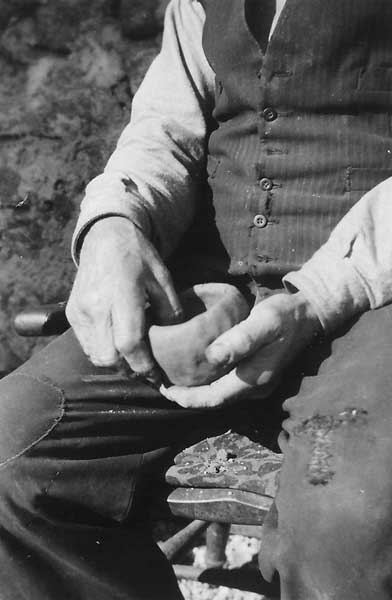
Black and white photograph of Hugh MacNeill of Balevullin in the early 1940s.
Hugh MacNeill of Balevullin demonstrates how his mother, Flora MacNeill, would make small clay pots known as craggans. After selecting a large lump of local clay, it was carefully worked by hand into a vessel with a neck and everted rim. The finished pot was allowed to dry then baked in the ashes of the fire. Milk was poured into and over it while still hot to make the surface less porous.
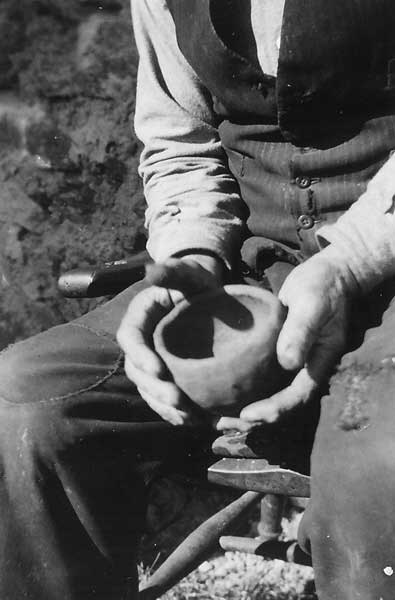
Black and white photograph of Hugh MacNeill of Balevullin in the early 1940s.
Hugh MacNeill of Balevullin demonstrates how his mother, Flora MacNeill, would make small clay pots known as craggans believed to have special curative properties, particularly in the case of consumption. The craggan was heated on the fire until very hot, removed with tongs and taken to the byre where the cow was milked directly into it. This was heated again and administered to the invalid.
Photocopied extract `Tiree craggans` by G. A. Holleyman from `Antiquity`, Vol XXI, 1947, pp 205-211. Description by George Holleyman of the making and use of Tiree craggans.
Series of five photographs of Hugh MacNeill of Balevullin demonstrating how his mother would make a craggan.
Courtesy of Mr George Holleyman
Hugh MacNeill of Balevullin, Tiree demonstrates how his mother, Flora MacNeill, would make small clay pots known as craggans which were believed to have special healing properties particularly in the case of consumption.
After selecting a large lump of local clay, it was carefully worked by hand into a vessel with a neck and everted rim. The finished pot was allowed to dry then baked in the ashes of the fire. Milk was poured into and over it while still hot to make the surface less porous.
The photographs were taken by George Holleyman, an archaeologist posted to RAF Tiree during World War II. He later published a paper ‘Tiree Craggans’ in the journal ‘Antiquity’.
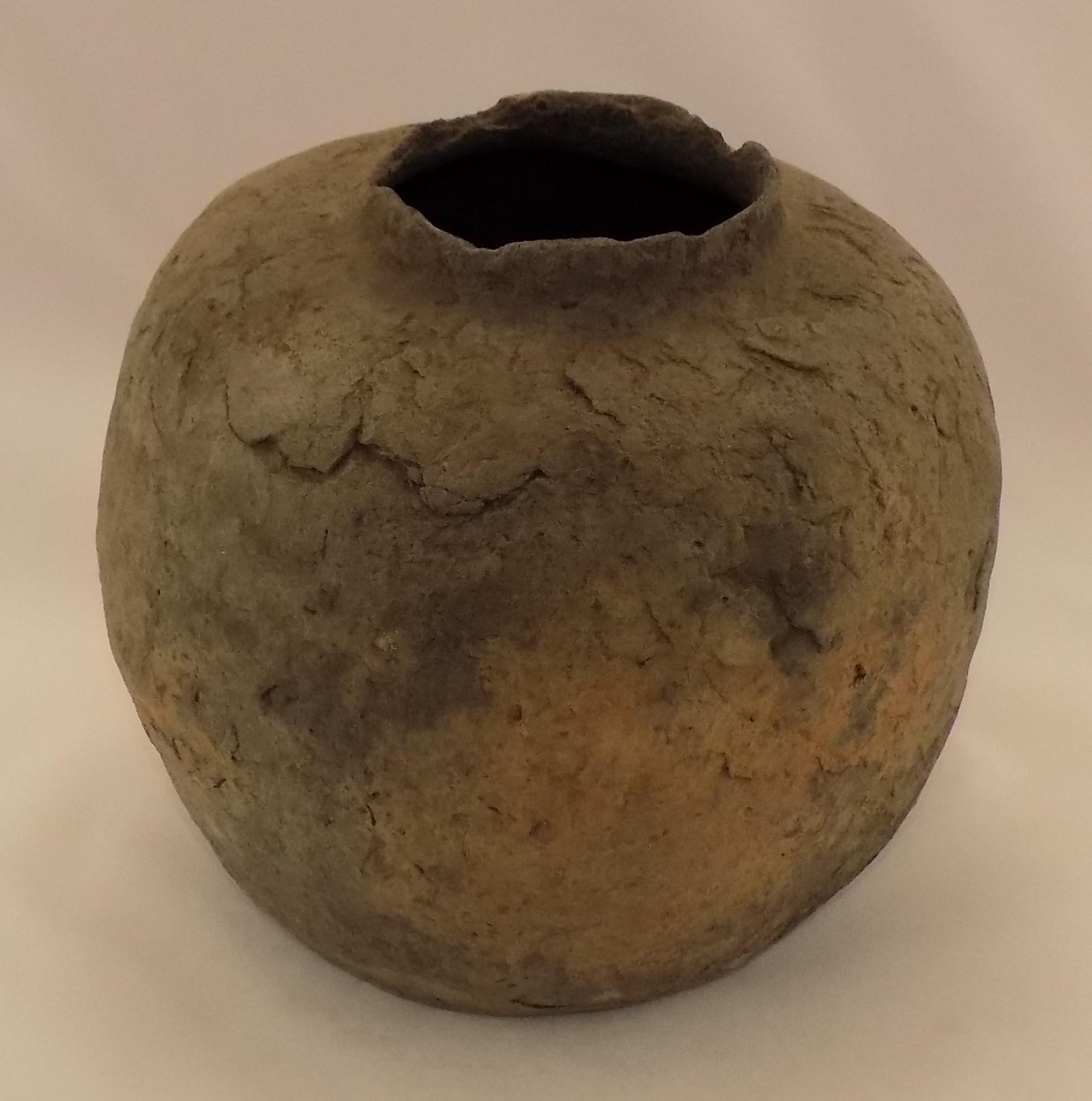
Large roughly-made unglazed grey clay craggan (205 x 220 mm) made on Tiree. Owned by Archie MacLean of Whitehouse, it was given to his neice who gave it to Reg and Meena Knapman for safe keeping until such time a suitable museum was set up in Tiree.
Small brown roughly-made pottery flagon / craggan (80 x 90 mm) made in Tiree, possibly made to administer milk to invalids. Owned by Archie MacLean of Whitehouse, it was given to his neice who gave it to Reg and Meena Knapman for safe keeping until such time a suitable museum was set up in Tiree.
George Holleyman, an archaeologist in the RAF police posted to Tiree during World War II, collected this small clay pot known as a craggan which he later donated to An Iodhlann.
Made by hand from local clay without the aid of a potter’s wheel, Tiree craggans were believed to have special curative properties, particularly in the case of tuberculosis of the lungs. The craggan was heated on the fire until very hot, removed with tongs and taken to the byre where it was filled with milk straight from the cow. This was heated again and administered to the invalid.
In a paper about Tiree craggans published in the journal ‘Antiquity’ in 1947, Holleyman wrote: ‘Each township had its potter who was always a woman…’ Flora MacNeill of Balevullin, who died aged eighty in the 1920s, was the last known craggan-maker on Tiree.