


Page of information about Dugald MacKinnon and his parents.
Page of information about Dugald MacKinnon and his parents, by Wallace Roberston and Louise MacDougall.

12074 Results Found
Displaying page 483 of 1208 pages of results:
Page of information about Dugald MacKinnon and his parents.
Page of information about Dugald MacKinnon and his parents, by Wallace Roberston and Louise MacDougall.
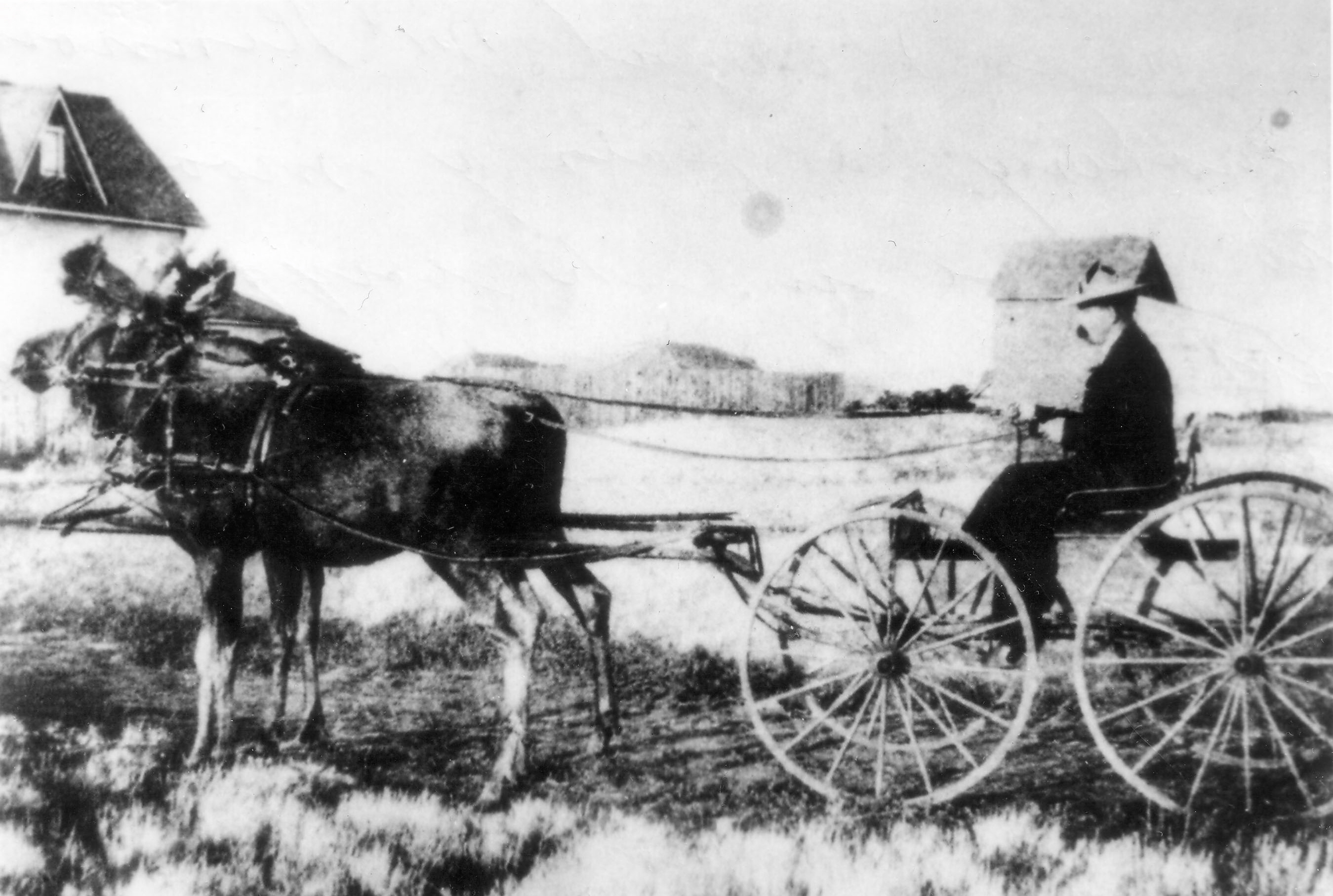
Dugald MacKinnon and his moose team
Photograph of Dugald MacKinnon and his moose team in the early 1900s.

Courtesy of Mr Wallace Robertson
John Mackinnon of Vaul and his wife Mary Ann MacDonald emigrated to Shoal Lake, Manitoba in 1878 with their two children Dugald and Sarah. Dugald, it was said, was akin to a ‘horse whisperer’ as he could tame the most difficult of horses. He was an avid horseman and traded horses across Manitoba and Montana.
He trained two moose calves captured by a farmer, Walter Anderson, and broke them to harness. They were a common sight on the streets of Brandon when Dugald began courting Mary Flora MacLean, and caused a sensation during the summer fair of 1905.
The owner of a visiting carnival offered to buy them but Anderson kept upping the price and the deal fell through. Dugald refused to have any more to do with the animals. He eloped with Mary Flora to Grand Forks, North Dakota where they were married.
Copy of a photograph of Dugald MacKinnon of Vaul and Brandon, Manitoba.
Dugald MacKinnon of Vaul and Brandon, Manitoba with his moose team (see 2007.31.1 for story).
Copy of a photograph of Dugald MacKinnon of Vaul and Brandon, Manitoba.
Dugald MacKinnon of Vaul and Brandon, Manitoba with the moose team he trained (see 2007.31.1 for story).
Copy of a newspaper cutting `Wild story about moose on the loose` by Fred McGuinnes.
Story about Dugald MacKinnon and his trained moose team.
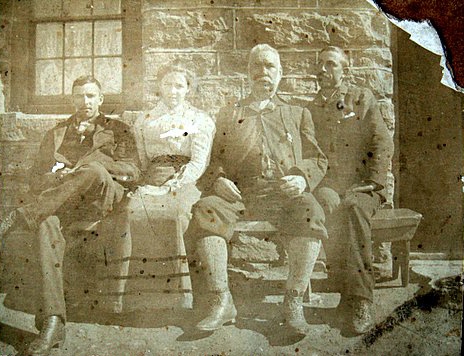
Black and white photograph of Neil and Mary Brown in South Africa.
L-R: Neil and Mary Brown, the children of Marion MacNeill from Hough; Robert Weir, husband of Marion`s sister Catherine McNeil; William Cawthorn, who later married Mary around 1905.
Tufthill Farm, South Africa
Photograph of Tufthill Farm in Eastern Cape, South Africa.

Courtesy of Mr Stanley Cawthorn
Marion MacNeill was born at Hough in 1841 and married Richard Brown in Glasgow in 1872. Five years later, her brother Donald married Mary Napier. Some time after that, the two couples emigrated to Eastern Cape, South Africa.
They had to contend with all that nature hurled at them, from torrential rain and hail storms to blazing heat and crop pests. Their nearest village and train station was Toise River about twenty-five miles away. Goods were fetched by ox wagon which took a full twelve hours for the round trip.
Births and deaths in the community were celebrated or mourned by all. When a neighbour died, the closest men turned out to lay out the body, put it into the coffin and hold the burial.
Black and white photograph of Tufthuill Farm in Eastern Cape, South Africa.
Marion and Donald MacNeill from Hough at Tufthuill Farm in Eastern Cape, South Africa. Marion married Richard Brown in 1872 and her brother Donald married Mary Napier in 1877. Some after that both couples emigrated to South Africa.
Hardback book `County of Argyll Sheep Marks` compiled by Major W. D. Allan, 1926.
Description of the horn brands, ear and keel marks used throughout Argyll to identify sheep, compiled by the Chief Constable of Argyll; attached letter dated 1952 giving the identification marks for Ulva.
Print-out of `Folklore from Coll` by Betty MacDougall, from a collection of CDs.
Collection of folklore from the Isle of Coll by Betty MacDougall.
Copy of a letter dated 2nd Oct 1850 re Caoles in Coll.
Letter dated 2nd Oct 1850 re the sequestration of the Caoles estate in Coll, owned by Colin Campbell.
Copy of an inventory of the estate of Colin Campbell of Balephetrish and Coll.
Inventory of the estate of Colin Campbell of Balephetrish and Coll.